
This post gives the plain-English version for those working in social housing compliance. It’s general information, not legal advice.
Key takeaways
- Water safety compliance in the UK is about controlling risks in building water systems, mainly Legionella and scalding, plus contamination risks such as backflow.
- If you control a property’s water system (as a landlord, employer, or managing agent), you have legal duties to assess risk and put sensible controls in place.
- In many domestic rentals, the risk assessment is meant to be proportionate, and testing is not usually required.
- In larger or more complex buildings, compliance becomes a live management job: temperatures, flushing, inspections, records, and clear ownership.
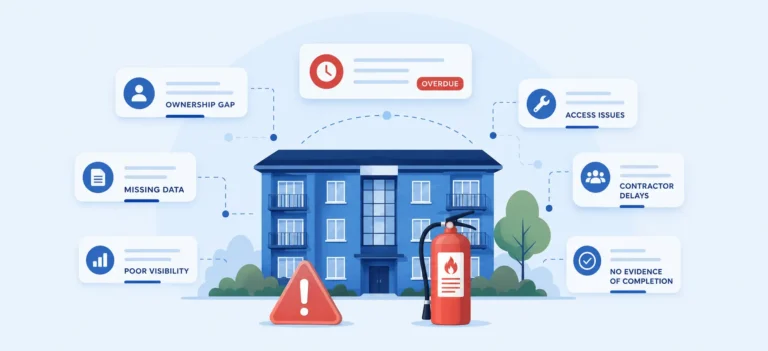
- The hard part is rarely the guidance. It’s staying on top of actions, evidence, and deadlines across multiple sites and contractors.
What is water safety compliance in the UK?
Water safety compliance is the ongoing work of keeping a building’s water system safe for the people using it. In practice, that means identifying foreseeable risks, putting controls in place, and keeping records so you can show the system is being managed.
For most UK properties, the centre of gravity is Legionella control: hot and cold water systems can create the conditions for Legionella to grow, especially where water sits unused. The Health and Safety Executive (HSE) frames this around dutyholders identifying and assessing sources of risk, setting up a control scheme, monitoring it, and keeping records. See HSE ACOP L8 (Legionnaires’ disease: control of legionella bacteria in water systems).
Water safety is not only Legionella, though. In property terms, it often also includes:
- Scalding risk (especially where vulnerable residents may be present) is often managed through thermostatic mixer valves (TMVs) and temperature regimes. See HSE hot and cold water systems guidance.
- Contamination risks, including backflow prevention in plumbing systems. The legal requirement sits within the Water Supply (Water Fittings) Regulations 1999.
Which UK rules sit behind it?
There isn’t one “water safety certificate” that covers every scenario. It’s a set of duties and guidance that apply depending on who controls the system and what type of building it is.
Two of the most commonly referenced sources for Legionella management are:
- HSE ACOP L8, which sets out what dutyholders should do and how to meet legal duties.
- HSE HSG274 technical guidance, which gives the practical detail (including hot and cold water systems).
Separately, the UK Health Security Agency also publishes public health guidance for organisations relying on safe water supplies, including the expectation of a risk assessment and water safety plan, and the importance of flushing during low usage. See UKHSA: A safe water supply.
Who is responsible for a property?
A useful way to think about it: responsibility follows control.
For rented homes, the HSE is explicit that landlords have legal responsibilities to keep tenants safe from health hazards, and that landlords should assess and control the risk from Legionella. The HSE also makes clear that this should be practical and proportionate for domestic rentals. See HSE: Legionella and landlords’ responsibilities.
In workplaces and more complex premises, responsibility typically sits with the “dutyholder” and the appointed “responsible person” managing the control scheme, records, and review cycle. That structure is covered in HSE ACOP L8.
What does “good compliance” look like day to day?
Think of it as a loop:
- Understand the system
What type of system is it (mains-fed, storage, recirculation, communal)? Where are dead legs, low-use outlets, tanks, and TMVs? HSE stresses you need to understand the system before assessing risks. - Risk assessment that matches the building
For many domestic rentals, HSE says the assessment does not need to be in-depth. - Control measures
For hot and cold systems, HSE sets out typical temperature control targets (for example, keeping cold water below 20°C and storing hot water at 60°C, with distribution targets at outlets), and recognises TMVs for scalding risk management. - Flushing and stagnation control
Low-use and vacant properties are where standards slip. HSE advises regular outlet use to reduce stagnation in domestic settings. UKHSA also flags flushing during periods of low usage. - Monitoring and records
In domestic rentals, HSE is clear that testing/sampling is not usually required and that there is no legal requirement for a “legionella test certificate”. For many landlords, keeping a record is still wise because it’s evidence if something goes wrong. - Review when things change
New tenants, long voids, changes to pipework, changes in use, or repeated issues should trigger a review. HSE notes the law doesn’t prescribe an annual review for landlords, but does expect periodic review when circumstances change.
Why it matters for UK properties (beyond “because it’s the law”)
- Resident safety and duty of care: Legionnaires’ disease can be severe, and risk increases where water sits unused.
- Operational control: Water actions tend to be scattered. Tanks, TMVs, outlets, and monitoring regimes live in different places, handled by different people. When evidence sits in email chains, audits become painful.
- Liability and reputational risk: HSE notes domestic properties are not proactively inspected, but if a tenant becomes ill and the water system is implicated, landlords may be liable and will need to show they met their duties.
A simple checklist you can use this week
- Confirm who “owns” water safety internally (named person, not a team inbox).
- List properties with communal water systems or known complexity first (they tend to carry a higher management burden).
- Check your last risk assessment date and whether anything has changed since.
- Add a plan for voids and low-use areas (flushing regime, documented).
- Make temperature checks and TMV work visible, not buried in contractor PDFs.
- Keep evidence where it can be found quickly if you’re asked.
Keeping it organised without turning it into a paperwork project
Most teams don’t struggle with understanding what needs to be done. They struggle with volume: multiple sites, multiple contractors, repeated actions, and deadlines that creep up.
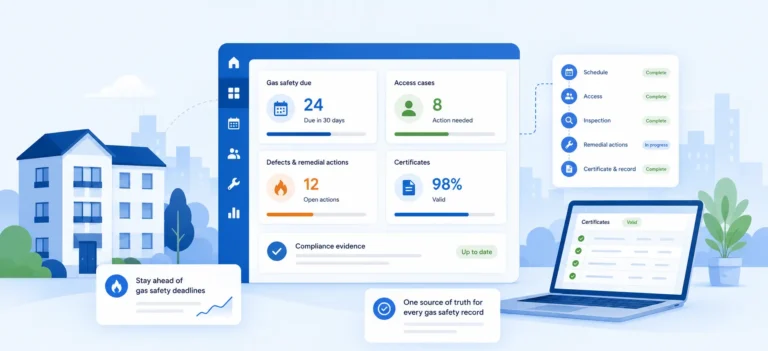
If you’re building a repeatable process, it helps to have one place that holds risk assessments, tracks actions, and keeps an audit trail. That’s the gap our water quality compliance stream is built around: visibility across assets, actions pulled from risk assessments, and evidence tied back to the property.