Key takeaways
- In England and Wales, the baseline is the Regulatory Reform (Fire Safety) Order 2005 (the Fire Safety Order), and it applies to the common parts of blocks of flats.
- The Fire Safety Act 2021 clarified that fire risk assessments must also consider the building’s structure, external walls (including cladding and balconies) and flat entrance doors in multi-occupied residential buildings.
- In England, the Fire Safety (England) Regulations 2022 guidance adds specific duties (with extra requirements based on height).
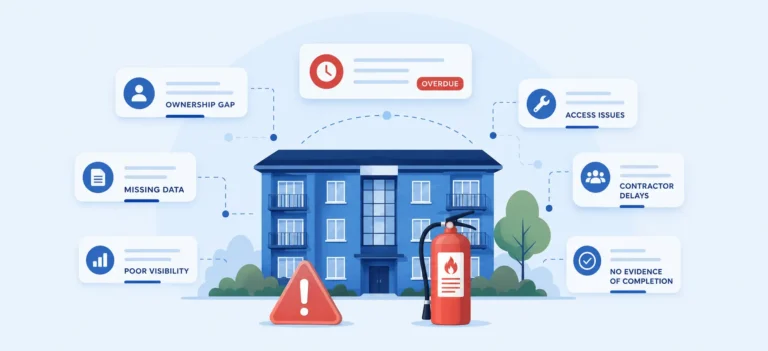
- Compliance only counts if you can evidence it: assessment, actions, checks, repairs, and resident communication.
What is fire safety compliance in the UK?
If you are searching “what is fire safety compliance”, here is the practical answer: it is meeting your legal duties to reduce fire risk and protect life whilst being able to prove you have done it.
For England and Wales, the Fire Safety Order puts duties on the “Responsible Person” for the premises they control, including the common parts of residential blocks. After Grenfell, the scope and expectations have risen. The Fire Safety Act 2021 made it explicit that fire risk assessments for multi-occupied residential buildings must cover the structure, external walls, and flat entrance doors, not just corridors and stairwells.
In England, the Fire Safety (England) Regulations 2022 apply to buildings with two or more domestic premises and add extra requirements. The Home Office guidance also makes clear that the Regulations generally do not apply within individual flats (except measures installed there for the safety of other residents, such as connected detection or sprinklers).
Across the UK, rules are not identical. Scotland’s framework sits under the Fire (Scotland) Act 2005 and the Fire Safety (Scotland) Regulations 2006. Northern Ireland uses the Fire and Rescue Services (Northern Ireland) Order 2006 and the Fire Safety Regulations (Northern Ireland) 2010.
The Fire safety compliance checklist
Confirm who holds the duty, per building
You need to name the Responsible Person for each building’s common parts.
You also need to record any managing agents, contractors, or other dutyholders with control over parts of the premises and how you coordinate between yourselves. Most gaps appear at handover points.
Keep a competent Fire Risk Assessment (FRA), in the right scope
You should commission a “suitable and sufficient” FRA for each relevant building and keep it under review.
You also should ensure that you make the scope explicit – include structure, external walls and flat entrance doors reflecting the Fire Safety Act requirements.
Turn the FRA into controlled actions, not a to-do list
You should log actions with the owner, deadline, and dependencies (e.g. access, procurement, scaffolding, etc.).
Capture any close-out evidence like photos, certificates, inspection notes and sign-off as well.
Fire doors: inspect, fix, record
In England, the Fire Safety (England) Regulations 2022 overview sets out expectations by height:
- Over 11 metres: you should be doing quarterly checks of communal fire doors and annual checks of flat entrance doors.
- All other relevant buildings: you should provide residents with fire safety instructions and information about the importance of fire doors.
Maintain building fire safety systems, with test records ready
Depending on the building, this can include alarms/detection in common parts, emergency lighting, smoke control/AOVs, dry risers, sprinklers, and other firefighting equipment. The standard is not “we service it”. You should be able to produce service logs, defect records, and completion evidence quickly.
High-rise buildings in England: build your “fire service pack”
For high-rise residential buildings (18m or 7+ storeys), the Regulations require sharing external wall information and floor/building plans with the local fire and rescue service. You are also required to have secure information boxes, wayfinding signage, and checks on firefighting lifts and essential equipment, including notification if the key kit is out of order for more than 24 hours. Your duties are summarised on the Fire Safety regulations page.
Resident information: make it repeatable
You should treat resident communications as a control, not a courtesy. Build a simple cadence (sign-up, post-works updates, annual refresh), then keep a record of what you issued and when. The England Regulations guidance explains what the sections on “information to residents” are trying to achieve.
Don’t miss inside-the-flat duties (England smoke and CO alarms)
Separate from the Fire Safety Order, landlords in England must meet the smoke and carbon monoxide alarms guidance, including the 2022 changes that brought registered providers of social housing into scope.
Be ready for enforcement and inspection
In England, fire and rescue authorities enforce fire safety law in residential blocks, including the common parts and (post amendments) the structure, external walls and doors. The Government’s Fire Safety Order enforcement guidance spells out that scope. Local authorities can also act on fire hazards in dwellings under HHSRS, using the HHSRS operating guidance.
A simple evidence pack that saves time later
Keep these per building, in one place:
- the latest FRA plus review history
- a live action log with close-out evidence
- the fire door inspection logs and repairs
- any service/test certificates for systems and equipment
- all resident information issued (with dates)
- your high-rise plans and fire service submissions (where relevant)
- a named Responsible Person and their coordination notes
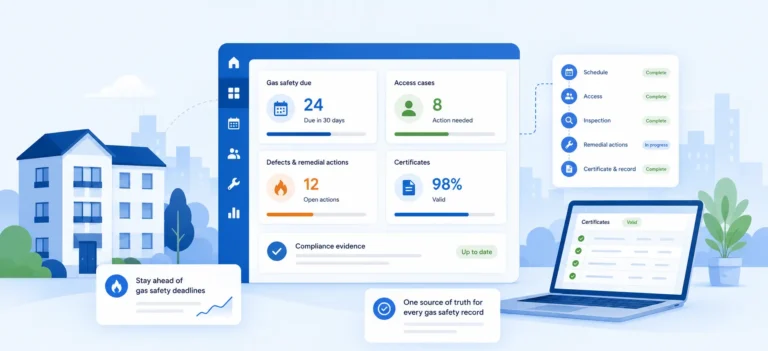
If you want to take a look at how technology could help you better structure fire safety evidence and actions across a portfolio, see our fire safety compliance page.