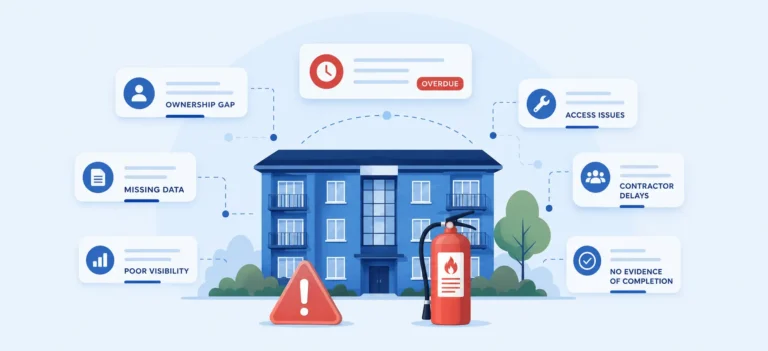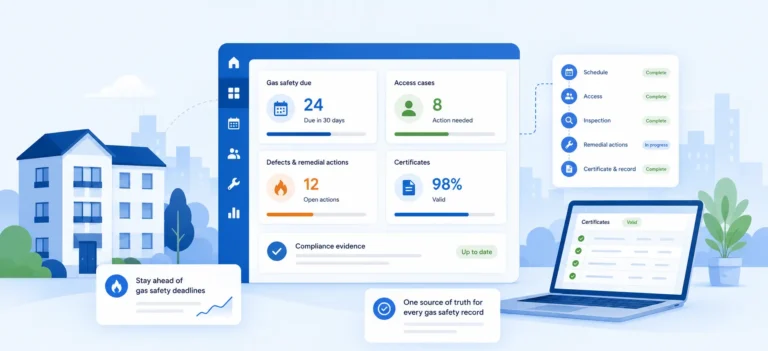
This guide lays out a practical way to stay on top of annual gas safety checks and stay compliant in the UK. Especially when teams are judged on dates, access, contractor controls, and proof.
Key takeaways
- Annual gas safety compliance in the UK comes down to one hard rule: checks must happen at intervals of no more than 12 months, and the right records must be kept.
- You can bring checks forward by up to two months and still keep the original renewal date, if you follow the 2018 “MOT-style” approach.
- Tenants must receive the latest record within 28 days, and new tenants must get it before they move in. Electronic is fine if they can access it, but paper must be available on request.
- If access becomes a problem, you need to show attempts at repeated, reasonable steps and clear evidence of what you did and when.
Start with the legal baseline (then build your process around it)
The core landlord duty sits in Regulation 36 of the Gas Safety (Installation and Use) Regulations 1998. It requires landlords to ensure each relevant appliance and flue is checked for safety within 12 months of installation and then at intervals of not more than 12 months, and that a record is made and retained with specific details.
The HSE explains how this applies in real life in its landlord gas safety FAQs, including that communal appliances, pipework and flues used by tenants are in scope.
Use the two-month window properly
The easiest way to avoid last-minute failure is to use the flexibility introduced in 2018: you can carry out the annual check up to two months before the due date and still retain the original deadline date. This is due to the changes made in Regulation 36A.
That window is gold in social housing because it gives you breathing room to rebook missed appointments without pushing homes into non-compliance.
Build a programme that doesn’t rely on perfect access
A working programme assumes some no-shows, some vulnerabilities, and some churn.
Work backwards from the renewal date
If the renewal date is your compliance line, the scheduling line needs to sit earlier. Use the two-month window to create a “first attempt” date that lands weeks before the deadline.
If the renewal date is your compliance line, the scheduling line needs to sit earlier. Use the two-month window to create a “first attempt” date that lands weeks before the deadline.
Segment stock by access risk
Not every property needs the same contact plan. Sheltered schemes, properties with known access issue histories, or homes where support services are involved usually benefit from earlier contact and more flexible slots.
Not every property needs the same contact plan. Sheltered schemes, properties with known access issue histories, or homes where support services are involved usually benefit from earlier contact and more flexible slots.
Plan for remedials, not just checks
A check can generate follow-on work. Treat the check as the start of a short workflow: appointment, check, record, remedials, and close-out evidence.
A check can generate follow-on work. Treat the check as the start of a short workflow: appointment, check, record, remedials, and close-out evidence.
Access: what “reasonable steps” look like
You must not use force to enter a property, and you need to show that you took all reasonable steps to comply. Check out this guidance on dealing with tenants, which sets out practical examples, including leaving a notice after an attempted visit and writing to the tenant explaining the legal requirement, while keeping a record of all correspondence.
In social housing terms, that usually means:
- a clear contact trail (letters, calls, SMS, email, visits)
- appointment options that match real life (out-of-hours where needed)
- escalation routes where access is repeatedly refused
- notes that are detailed enough to stand up to scrutiny
Contractor controls: “Gas Safe registered” is the start, not the finish
Annual checks must be carried out by a registered engineer. Check out this page onwho can do a gas safety check to get a better idea about where non-registered work ends and Gas Safe work begins.
Operationally, keep it simple:
- verify the business or engineer on the Gas Safe Register
- check the engineer is qualified for the type of appliance they’re working on
Records: get the timing right (and don’t wait for remedials)
Your record keeping has two parts: what the record contains, and when it’s issued.
Regulation 36 sets out what must be included in the record and how long it must be retained (until there have been two further checks, or two years for an appliance removed from the premises).
You also need to issue the latest record to existing tenants within 28 days, and to new tenants before they move in. Electronic delivery is acceptable if the tenant can access it, but you must provide paper if asked.
One other point that catches teams out: the gas safety check record should be issued on completion of checks and not held back while defects are fixed.
Communal systems and shared responsibility: don’t leave gaps
Social landlords often sit inside bigger building arrangements.
If you are a landlord in a building you do not own, your arrangements with the building owner need to ensure communal appliances, flues and pipework used by your tenants are maintained and checked, and that evidence is available to you (and to your Gas Safe engineer).
That’s where compliance can quietly fail: the check is done, but the evidence isn’t accessible when you need it.
A quick compliance self-check
If you want a fast sense-check of your annual process, ask:
- Can we name the renewal date for every relevant appliance and flue, and prove the last check?
- Are first appointments set early enough to use the two-month window if access fails the first time?
- Do we have a documented “reasonable steps” process for access, with evidence in the case file?
- Are records issued within 28 days, and before move-in for new tenants, every time?
If any of those answers are “not consistently”, that’s where your programme needs tightening.
To learn more about how technology could be used to help maintain your gas safety compliance, check out True Compliance’s Gas Safety Compliance stream.