
This guide outlines the primary regulations and the practical responsibilities they impose on landlords, managing agents, and building operators. (It’s general information, not legal advice.)
Key takeaways
- The backbone in England and Wales is the Fire Safety Order, which sets duties for the “Responsible Person” to manage risk in relevant premises.
- The Fire Safety Act 2021 clarified that, for multi-occupied residential buildings, fire risk assessments must consider the building’s structure, external walls (including cladding and balconies), and flat entrance doors.
- In England, the Fire Safety (England) Regulations 2022 add extra duties, including fire door checks and (for high-rises) plans, signage, and information-sharing with fire and rescue services.
- For higher-risk buildings in England, the “golden thread” is about keeping the right safety information accurate, accessible, and maintained across the building lifecycle.
- Scotland and Northern Ireland have their own fire safety legislation and guidance, so you can’t copy-paste an “England” approach and assume it holds.
The three layers of UK fire safety regulation
Most confusion comes from mixing up three different things:
- Fire safety in occupation (how you manage risk day to day)
- Building standards (how a building is designed, built, or altered)
- Building safety regime for higher-risk buildings (how safety is managed and evidenced over time)
This guide focuses mainly on the first and third, because that’s where landlords and operators feel the workload.
England and Wales: the Fire Safety Order
The starting point is always the Regulatory Reform (Fire Safety) Order 2005. It’s the framework that requires fire risk assessment, prevention measures, maintenance, staff training (where relevant), and ongoing review.
Who is the “Responsible Person”?
Under the Fire Safety Order, duties sit with the Responsible Person (and sometimes more than one, depending on control of the premises). This Home Office guide on identifying the Responsible Person explains the need to coordinate where duties overlap, rather than letting gaps appear between parties.
What parts of housing does it cover?
In blocks of flats, the Fire Safety Order is mainly about common parts (stairs, corridors, plant rooms, risers, lobbies), but later legislation clarified that the assessment must also properly consider certain building elements that directly affect fire spread and evacuation.
The Fire Safety Act 2021: why it matters for landlords
The newer Fire Safety Act 2021 didn’t replace the Fire Safety Order. It clarified what should already have been treated seriously in many multi-occupied buildings: the structure, external walls, and flat entrance doors.
If you manage blocks, this changes the tone of your FRA conversations. It’s not just “are escape routes clear?” It’s also “what is the external wall system, and what do we know about how it performs in a fire?”
A useful thing to note is that the government guidance on commencement says that you don’t necessarily need to redo an FRA from scratch if it already addresses the clarified scope, but you may need to update it based on competent advice and whether a deeper external wall appraisal is required.
Fire Safety (England) Regulations 2022: the extra duties (England only)
In England, the Fire Safety (England) Regulations 2022 sit alongside the Fire Safety Order and add specific requirements for residential buildings with two or more domestic premises, with more duties triggered by height. Here are a few areas that routinely catch landlords out:
Fire door checks (including flat entrance doors)
The Home Office guidance sets out a requirement for regular checks and keeping doors in efficient working order, including self-closers. These regulations don’t magically set a single “right” fire rating for every flat entrance door; performance remains a matter for the FRA and applicable guidance.
High-rise requirements: plans, signage, information boxes
For existing high-rise residential buildings in England, duties include building and floor plans, wayfinding signage, and a secure information box for firefighters. The legal requirements can be found in the Regulations themselves.
If you want a plain-English explanation for smaller blocks, the Home Office guide to making a small block of flats safe from fire is one of the clearer summaries of how these duties fit together.
Building Safety Act 2022: higher-risk buildings and the “golden thread”
For higher-risk buildings, fire safety isn’t just about having documents. It’s about maintaining a reliable record of what’s true about the building and how risk is controlled.
The government’s golden thread guidance is that information should be accurate, up to date, accessible to those who need it, and maintained through design, build, and occupation. This “Making Buildings Safer” document is also a useful companion for understanding what the golden thread is trying to achieve in real terms.
There’s also an important crossover: Home Office enforcement guidance mentions that fire risk assessment work under the Fire Safety Order can feed into building safety duties, rather than living in a separate universe.
Scotland and Northern Ireland: similar intent, different rules
Fire safety duties across the UK share the same aim: identify risk, put controls in place, keep them working, and review. But the legal routes differ.
- In Scotland, dutyholders operate under the Fire (Scotland) Act 2005 and Fire Safety (Scotland) Regulations 2006, with the Scottish Fire and Rescue Service providing its own guidance on fire risk assessment responsibilities.
- In Northern Ireland, the Northern Ireland Fire & Rescue Service provides business fire safety guidance aligned to the Fire and Rescue Services (Northern Ireland) Order 2006.
If your stock spans borders, build separate compliance views by jurisdiction. It will save pain later.
What “good” looks like in an audit
Regulators and enforcing authorities don’t just want statements. They want proof you’re in control. A sensible evidence set usually includes:
- Current fire risk assessment(s), with scope and review cycle clear
- Action tracking: ownership, deadlines, completion evidence
- Fire doors: inspections, defects, repairs, and rechecks
- System maintenance: alarms/detection (where fitted), emergency lighting, smoke control, risers, extinguishers, lifts (where applicable)
- Resident information and building instructions, issued and recorded
- For English high-rises – plans, signage, an information box, and a record of what was shared with the fire and rescue service
And don’t ignore in-flat alarm duties in England: the government’s guidance on smoke and carbon monoxide alarms sets additional landlord requirements and also references the 2022 amendment extending duties to registered providers of social housing.
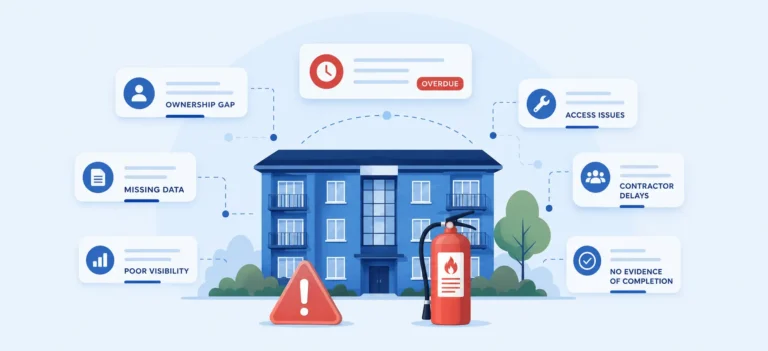
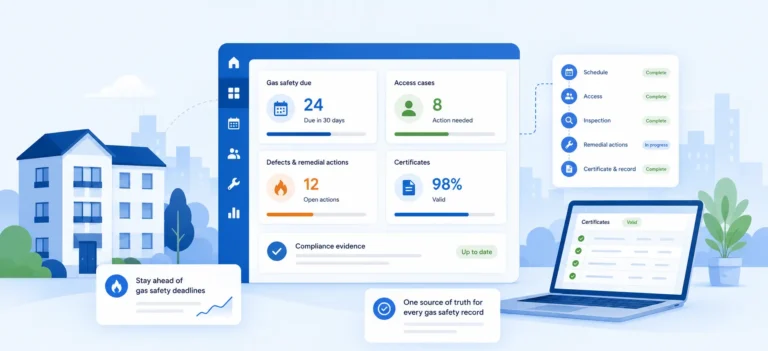
If you’re trying to standardise fire safety compliance across a portfolio, the goal is simple: one place to see the latest assessment, what it raised, what’s closed, what’s overdue, and what evidence backs it up. If you’re struggling to maintain your fire safety compliance, it might be sensible to look at how software can help. A good place to start is checking out True Compliance’s Fire Safety page.