It is no surprise that AI is being discussed as a release valve. But there is a quiet risk building beneath the enthusiasm: the belief that better tools can compensate for weak controls, thin capacity or inconsistent oversight. They cannot.
AI can assist compliance. It cannot carry accountability.
Key takeaways
- AI is not a golden bullet; it’s a support tool within a controlled compliance system.
- Over-reliance creates risk, especially when outputs are accepted without checking source documents.
- Complacency remains one of the sector’s most persistent weaknesses.
- Providers are balancing compliance, decarbonisation, resident expectations and financial constraint.
- The durable answer is operational discipline paired with stronger systems – not shortcuts.
The Pressure Is Real
We all know that the compliance environment is not getting lighter.
The Regulator of Social Housing has reinforced consumer standards and now expects providers to demonstrate grip, assurance and timely remediation (Consumer Regulation Review 2023–24). At the same time, the introduction of time-bound expectations under Awaab’s Law has shifted damp and mould from an operational challenge to statutory exposure.
Add to that:
- Decarbonisation targets under the Social Housing Decarbonisation Fund.
- Cost inflation in repairs and maintenance.
- Complaints scrutiny following the Housing Ombudsman’s Spotlight reports.
- Heightened tenant engagement requirements.
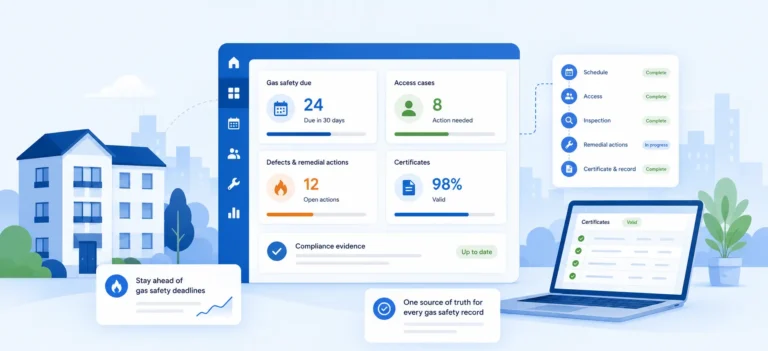
It’s a crowded agenda. Against that backdrop, AI tools promise faster document reviews, automated risk summaries, policy comparisons, trend analysis and reporting support. For compliance teams buried in spreadsheets and PDFs, that is appealing.
The temptation is understandable.
The Myth of the Golden Bullet
Every few years, the sector looks for a breakthrough solution. A new framework. A new piece of data to gather. A new external partner. Now, it’s looking at AI.
The narrative often drifts into reasonable but absolute assumptions. Claims that AI can bring automated assurance, instant insight, and predictive risk scoring.
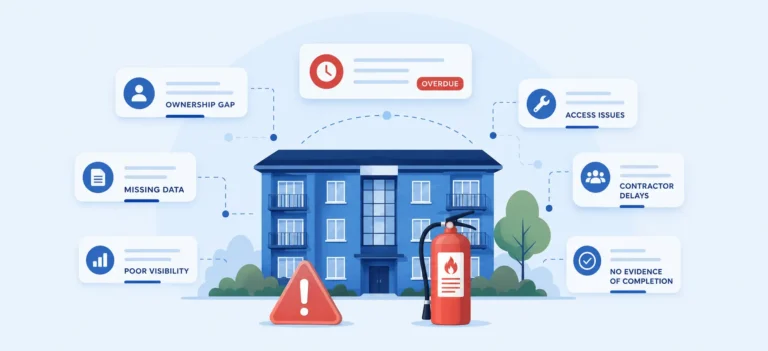
But compliance is not failing because teams lack summarisation software. It fails when:
- The source data is wrong.
- Follow-up actions are not tracked.
- Exceptions are tolerated.
- Escalations stall.
- Ownership is blurred.
No algorithm fixes a culture that is prepared to look away from uncomfortable findings.
AI can synthesise information. It cannot decide whether a risk is being accepted implicitly. It cannot challenge a colleague who chooses not to escalate. It cannot replace professional judgement.
The danger is not the technology itself. It is the belief that the technology removes the need for scrutiny.
When People Stop Reading
A more subtle risk is also starting to creep in: output acceptance.
If a tool reviews a fire risk assessment and produces a neat summary, how many people go back to the original document? If a system flags “low risk,” how often is that interrogated? If a model identifies trends in damp and mould cases, who validates the underlying data?
Compliance has always depended on evidence. Evidence lives in source documents, site visits, inspection notes and resident communication. If people stop engaging with the raw material and rely solely on generated outputs, blind spots will grow.
AI models are ultimately trained on patterns. They do not understand the local nuance of a single building, the history of a contractor’s performance, or the context behind a resident complaint.
Accepting outputs as truth without any challenge creates a new form of complacency. One that feels modern and efficient while quietly eroding assurance.
Complacency: An Old Enemy in New Clothing
Complacency has always been a recurring threat in compliance.
Not wilful neglect, but the slow erosion of accuracy:
- “It’s probably fine.”
- “We’ve never had an issue before.”
- “We’ll pick that up next quarter.”
There is also genuine fear. Fear of surfacing systemic weaknesses. Fear of reputational damage. Fear of regulatory consequence. Sometimes in compliance, it can feel safer to let minor inconsistencies pass than to confront what they might reveal.
AI is, unfortunately, making that easier, even if that is by accident. A clean dashboard gives comfort, the high-level summary reassures, and the risk score simplifies complexity.
But if the underlying operational discipline is weak, and the reassurance is cosmetic.
All of the hard work still remains:
- Verifying data quality.
- Challenging assumptions.
- Following through on overdue actions.
- Documenting decisions properly.
- Revisiting historic cases.
There isn’t a system that removes the need for that effort.
Capacity Pressure Is Driving Behaviour
It would be unfair to frame over-reliance on AI as laziness. Most compliance teams are now operating under sustained strain. After all, compliance is now juggling:
- Statutory compliance programmes.
- Retrofit delivery and funding deadlines.
- Resident engagement reforms.
- Complaint investigations.
- Contractor performance concerns.
- Budget control.
We all know that headcount has not always grown in line with responsibility.
In that environment, tools that accelerate document review or automate reporting can be genuinely valuable. They create breathing room. They reduce manual repetition. They help surface patterns that would otherwise be missed.
But support is not a substitute.
AI may help draft a compliance report. It does not stand in front of the board. It does not answer the regulator. It does not sign the statement of assurance.
Accountability remains human.
Operational Discipline First, Systems Second
The best model of compliance is not “AI-led compliance.” It is disciplined compliance supported by capable systems. Humans should ultimately be responsible for:
- Clear ownership of each risk area.
- Defined escalation routes.
- Structured case management.
- Evidence standards that are understood and audited.
- Regular deep-dives into source documentation.
- Performance metrics focused on outcomes, not just activity.
Once those foundations are in place, AI becomes an accelerant rather than a crutch.
It can:
- Highlight anomalies across thousands of records.
- Compare policy versions for drift.
- Surface recurring failure points.
- Assist in preparing audit packs.
But it works inside a framework that already values rigour. Without that framework, AI simply processes flawed inputs faster.
Accountability Does Not Delegate
Regulators do not regulate your AI tools. They regulate providers.
When a serious detriment case arises, or a maladministration finding is issued, the question will not be “which model generated the report?” It will be “who was responsible, and what did they know?”
That is the line AI cannot cross.
Used well, it can enhance visibility and reduce friction. Used carelessly, it can amplify complacency and mask fragility.
The sector does not need a golden bullet. It needs steadiness. Strong governance, disciplined operations, accurate data, and leaders prepared to confront uncomfortable truths.
Technology can assist with that. It cannot replace it.