Key takeaways
- Annual gas safety checks are mandatory for the gas appliances and flues you provide, and maintenance is a separate duty.
- Checks and gas work must be done by a Gas Safe registered engineer.
- Give tenants the latest Landlord Gas Safety Record (LGSR/CP12) on time, and keep it for the right period.
- Use the two-month early-check window to avoid missed deadlines, then keep the evidence trail that proves the annual cycle.
Confirm what’s in scope for your property
The government’s guidance on the “what needs checking” page states that all permanent and portable gas appliances and flues in scope require an annual gas safety check, and anything you own and provide for tenant use sits within your duties.
Some quick checks you can make:
- Tenant-owned appliance? The tenant is responsible for the appliance check, but landlords can still be responsible for parts of the associated installation and pipework.
- No gas appliances at all? No annual check required, but you still need to maintain relevant pipework safely.
- Communal boiler/plant? It still needs maintenance and annual checking, even if coordination sits across multiple parties.
Book a Gas Safe registered engineer (and don’t accept “sign-off”)
The guidance on this is unambiguous – the check must be carried out by a Gas Safe registered engineer, and it’s not acceptable for a registered engineer to “sign off” work done by someone unregistered.
You need to verify your engineer’s registration via the Gas Safe Register.
Schedule the annual check with a two-month buffer
Gas equipment that you supply must be installed and maintained by a Gas Safe engineer, and each appliance and flue needs an annual gas safety check.
To reduce deadline risk, the Approved Code of Practice changes made in 2018 give you some flexibility. You can carry out the annual check in the two months before the due date and keep the existing expiry date.
Treat maintenance as ongoing, not an afterthought
Maintenance is separate from record keeping. What that means in practice is that:
- For pipework – keep installation pipework (meter to appliance) safe. Ask your engineer to test for soundness and visually inspect pipework where practical.
- Appliances/flues – service to manufacturer’s instructions. If those aren’t available, annual servicing is required unless the engineer advises otherwise.
If defects are found, take appropriate action. The LGSR should be issued on completion of the checks and not held back while remedials are arranged.
Get the LGSR/CP12 right: content, retention, tenant copies
Here is where you can find the minimum content required on the record (appliance/flue details and location, check date, property address, landlord/agent details, defects and remedial action, and engineer identity, including registration number and signature).
The retention rules:
- Keep records for at least two years.
- If you use the two-month early-check window, keep the record until two further checks have been completed to evidence the timing chain.
When giving copies to tenants:
- Existing tenants should receive the records within 28 days of completion.
- New tenants should receive the records before move-in.
- Electronic copies are allowed if they’re secure, printable, and the tenant can access them. You must provide paper records if requested.
No access: build the evidence trail
Your tenancy agreement should allow access for safety work. However, you must not use force, and you should be able to show “all reasonable steps”. The general consensus is that you should leave a notice after an attempted visit, write to explain the legal requirement, and keep records of repeated attempts and correspondence.
A checklist for each property
Before the visit
- List appliances and flues in scope (including communal systems)
- Book and verify a Gas Safe registered engineer
- If access is tricky, start contacting early and log every attempt
After the visit
- File the LGSR and confirm it includes the required details
- Send the tenant copy on time (and keep proof)
- Track defects and remedials to completion
Note: In England, separate rules cover smoke and carbon monoxide alarms. Government guidance says CO alarms should be fitted in rooms with fixed combustion appliances (excluding gas cookers).
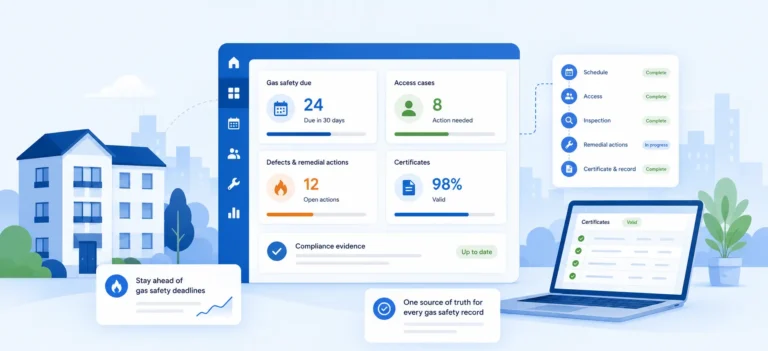
If you’re interested in understanding how technology could help you manage all of these requirements, check out True Compliance’s Gas Safety compliance stream.