
Key takeaways
- For UK landlords in Great Britain, the gas appliances and flues you provide must be checked for safety at intervals of not more than 12 months. That’s the legal baseline in Regulation 36.
- You can carry out the annual check-up to two months early and keep the existing deadline date, which helps when access is tight across a large housing stock.
- The “inspection” that proves compliance is the Landlord Gas Safety Record (often called a CP12). Tenants must receive it within 28 days, and before move-in for new lets.
- Northern Ireland follows separate regulations (2004), so you need to use NI-specific guidance if you operate there.
The short answer for landlords (in Great Britain)
If you rent out homes in England, Scotland, or Wales, landlord-provided gas appliances and flues must have a safety check at least every 12 months, measured as “intervals of not more than 12 months since it was last checked”. That wording matters because it’s about the gap between checks, not the calendar year.
The rule sits in Regulation 36 of the Gas Safety (Installation and Use) Regulations 1998 and is explained in a little more detail in the HSE’s landlord gas safety FAQs.
What counts as an “inspection” for compliance?
For landlords, the compliance-critical inspection is the gas safety check carried out by a properly registered engineer, with the results recorded in a Landlord Gas Safety Record.
HSE’s gas safety record guidance explains what the record is, what it must contain, and what landlords must provide to tenants.
If your team is using “inspection” to mean a service, maintenance visit, or responsive repair, those can be sensible risk controls, but they are not a substitute for the landlord gas safety check required under Regulation 36.
The 12-month rule and the two-month window that makes it manageable
Annual means “no more than 12 months”
Regulation 36 requires checks within 12 months of installation and then no more than 12 months after the last check.
You can inspect up to two months early without shifting the deadline
HSE’s Approved Code of Practice guidance (L56) explains the intent of the 2018 change: checks can be carried out in the two months before the due date while keeping the same expiry date.
For social landlords, this is the practical lever. It gives you space to rebook when residents miss appointments, without pushing homes over the line.
New appliances can be aligned (but only once)
HSE’s “Gas safety checks: what if…?” sets out the one-off flexibility for new appliances to help realign dates with existing checks in the property, linked to Regulation 36A.
What needs checking, and whose responsibility is it
The scope isn’t “whatever the contractor happened to look at”. Regulation 36 defines “relevant gas fitting” and includes landlord-provided appliances, installation pipework, and appliances or pipework that serve the premises and are owned or controlled by the landlord.
Where tenant-owned appliances are involved, there is a bit of a split: tenants are responsible for checks on their own appliances (and the flue if it only serves their appliance), while landlords are usually responsible for associated flues, pipework, or chimneys.
The record deadlines that sit alongside the inspection frequency
Even if your checks are on time, you can still fall short on the admin that proves it. You need to:
- give existing tenants the latest record within 28 days
- give new tenants the current record before they move in
Electronic delivery is fine if the tenant can access it.
What about homeowners and owner-occupied homes?
If you’re not a landlord, the question usually shifts from “compliance” to “good practice”.
The Energy Saving Trust’s boiler service explainer recommends an annual service by a Gas Safe registered engineer and sets out what a service typically includes.
That’s not a landlord compliance requirement by itself, but it’s a useful benchmark for household safety and reliability.
Northern Ireland: different regulations
If you operate in Northern Ireland, you need to follow the Gas Safety (Installation and Use) Regulations (Northern Ireland) 2004 rather than the Great Britain regulations. The NI landlord duties are summarised in HSENI’s landlord duties leaflet. The law you have to follow is in Regulation 36 (NI).
Staying compliant in social housing: make the calendar work for you
The legal frequency is clear. The hard part is delivering it at scale.
A simple pattern helps:
- Schedule first appointments inside the two-month window for properties with known access issues.
- Track by “deadline date”, not “month due” so you don’t drift into late checks.
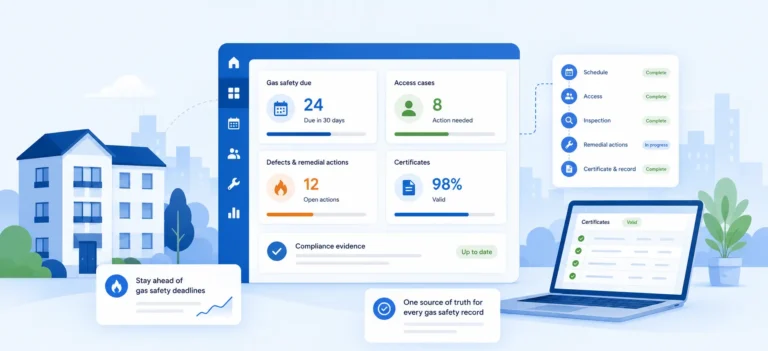
- Separate the check from remedials in your workflow, but keep the evidence linked in one place (check record, defects, follow-up actions).
- Issue the record on time as a standard step, not an afterthought.
If you’re struggling to keep the timings straight, it might be worth looking at compliance software that automatically keeps track of those things for you. You can learn a little more about it on True Compliance’s Gas Safety Compliance page.