
Here’s what gas safety compliance duties really mean in practice, and where teams usually get caught out.
Key takeaways
- Your core legal duties sit in Regulation 36 of the Gas Safety (Installation and Use) Regulations 1998 – maintain landlord-supplied gas fittings, complete safety checks on time, and keep proper records.
- “Annual” means no more than 12 months between checks, but you can do the check up to two months early and keep the same renewal date.
- Tenants must get the latest record within 28 days, and new tenants must get it before they move in (electronic delivery is allowed if they can access it).
- If a tenant won’t allow access, you still need a clear trail showing repeated, reasonable steps to complete the check.
Where the legal duties come from
The Health and Safety Executive lays out landlord responsibilities in plain terms on its page Landlords’ responsibility for gas safety. The legal backbone to all of this is the Gas Safety (Installation and Use) Regulations 1998, with landlord-specific duties covered in Regulation 36. The timing flexibility comes from Regulation 36A.
Duty 1: Maintain what you provide (including pipework and flues)
Your duties cover gas appliances, installation pipework, and flues that you own, provide, or control, including items that serve the premises indirectly (for example, via a communal setup). That scope is baked into the definition of “relevant gas fitting” in Regulation 36.
A common social housing wrinkle: tenant-owned appliances. If a tenant has their own gas appliance you did not provide, you’re not responsible for the appliance itself, but you are responsible for parts of the associated installation and pipework.
Duty 2: Use the right people
Gas safety checks must be done by a properly registered engineer. You can see more about the requirements and boundaries here. The public route for verification is ultimately the Gas Safe Register.
One point worth stating bluntly: engineers don’t “own” your compliance. Gas Safe’s own guidance highlights that the landlord remains responsible for having checks in place and up to date.
Duty 3: Complete safety checks on time (and use the 2-month window)
The big thing to note in Regulation 36 is timing: each appliance and flue in scope must be checked within 12 months of installation and then at intervals of not more than 12 months.
If you manage a large stock, the difference between “due date” and “deadline date” matters. Since the 2018 amendment, you can carry out the check up to two months before the deadline date and still keep the same renewal date, as set out in Regulation 36A.
That window is what makes access planning workable. Without it, you’re forced into late scheduling, then chasing, then slipping.
Duty 4: Create the record, keep it, and issue it on schedule
Regulation 36 also explains what the record must contain (date, address, details of appliances/flues checked, defects, remedials, engineer signature and registration number, and more).
You can find a little more operational detail here – including retention. You need to keep records until two further gas safety checks have been carried out.
Issuing the record is where organisations often lose points in audits:
- existing tenants need it within 28 days
- new tenants need it before they move in
Electronic delivery is acceptable if the tenant is happy and can access it, with paper available if needed.
Duty 5: Manage access and prove your attempts
You can’t force entry, but you also can’t shrug and move on.
You need to communicate clearly, make repeated attempts, leave notices, and keep a written trail of what you did and when. That evidence trail is what shows you took “reasonable steps”.
In social housing, “reasonable steps” usually means a consistent pattern:
- early contact (so you can rebook inside the 2-month window)
- several appointment options
- a clear escalation route for repeated refusals or no-shows
- case notes that would make sense to an auditor who has never seen the property
Duty 6: Stay tight around lettings and tenancy changes
If the tenancy changes, don’t treat the certificate as “admin later”. Before a new tenancy starts, you must provide a current record. A good thing to note is that a record remains current for 12 months from the check date, and can be copied to new tenants if still in date.
A quick duty checklist for social landlords
- Can you list every in-scope appliance and flue by address, including communal systems that serve your dwellings?
- Are checks scheduled early enough to use the two-month window without slipping the annual cycle?
- Are engineers verified and properly registered?
- Are records issued within 28 days and before move-in, with a clear audit trail?
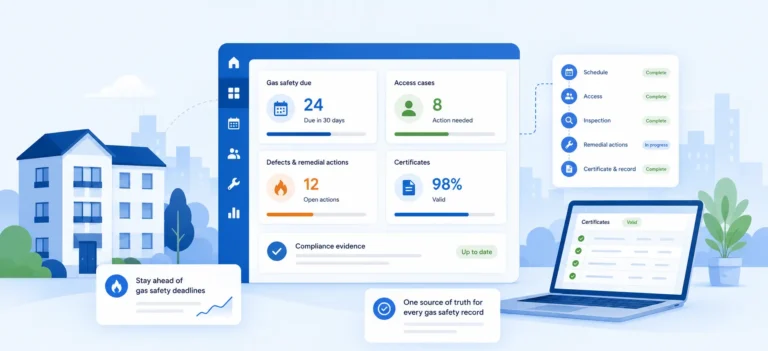
If you’re struggling to maintain your gas safety compliance rates, then it might be a good idea to look at software that can help. You can check out how this works on True Compliance’s Gas Safety Compliance page.