
The Fire Safety Order is the main fire safety law for England and Wales. It applies to almost all premises apart from individual private dwellings, but it does apply to shared and common parts in blocks of flats and HMOs. If you’re just looking for a plain-English overview of the law, you can find it in the London Fire Brigade’s explainer on the Fire Safety Order.
Key takeaways
- The full legal text is the Regulatory Reform (Fire Safety) Order 2005.
- The law places duties on a “Responsible Person” and requires a suitable and sufficient fire risk assessment.
- For multi-occupied residential buildings, the Fire Safety Order scope includes the structure, external walls (including cladding and balconies) and flat entrance doors.
- In England, the Fire Safety Order is supplemented by the Fire Safety (England) Regulations 2022 guidance (including fire door checks and resident information duties).
- Serious non-compliance can lead to criminal sanctions.
What the Fire Safety Order covers (in plain terms)
The Fire Safety Order is built around “general fire precautions”, which is the shorthand for the practical controls that reduce risk and protect people if a fire starts. Those controls are then tied to specific duties in the Order itself. If you want to read it end to end, you should start with the Fire Safety Order contents page.
It came into force on 1 October 2006 and applies across England and Wales, replacing and consolidating older fire safety regimes.
Who is the “Responsible Person”?
Responsibility sits with the person or organisation that has control of the premises. In a workplace, that’s often the employer. In housing, it’s often the landlord, managing agent, or whoever controls the common parts.
Every premises in scope should have an identifiable Responsible Person, and sometimes there is more than one. Where duties overlap, they’re expected to cooperate and coordinate rather than leave gaps. See the government’s ‘A guide for persons with duties under fire safety legislation’.
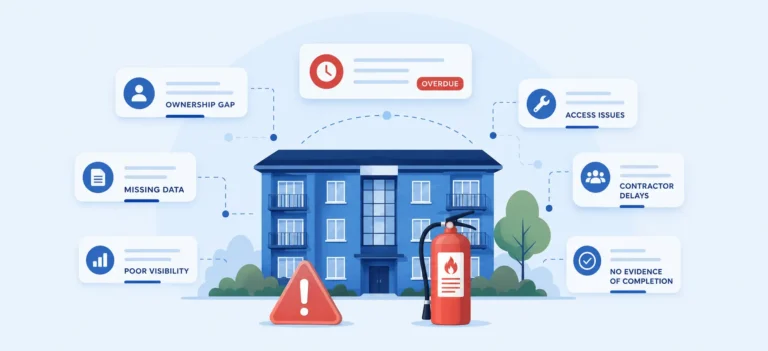
Worth knowing: if you cannot name the Responsible Person for each building (and for each part of that building), you are not compliant. You only have some paperwork.
The fire risk assessment duty (and what “suitable and sufficient” looks like)
The Fire Safety Order requires a fire risk assessment and expects it to be “suitable and sufficient”. This is a duty on the Responsible Person when the premises fall within scope.
There is a practical five-step method most people recognise: identify hazards, identify people at risk, evaluate and act, record and plan, and keep it under review (see Fire risk assessments: your responsibilities).
For compliance, the assessment needs to be more than a snapshot:
- Clear scope (exactly what areas and systems were assessed)
- Findings tied to risk and priority
- Actions with owners, deadlines, and completion evidence
- A review trigger list (works, incidents, changes in use, time-based cycle)
The “day-to-day” duties people miss
Most enforcement cases aren’t about having no FRA. They’re about controls not being maintained, actions not being closed, or changes not being picked up.
The Fire Safety Order includes duties that, in practice, boil down to:
- putting fire safety arrangements in place (not just writing them down)
- keeping escape routes usable and protected
- maintaining fire safety equipment and systems
- providing information and instruction where needed
- cooperating with other dutyholders in shared buildings
If you want a single document that explains those duties without legal jargon, the Home Office’s guide for persons with duties under fire safety laws is the most useful starting point.
Blocks of flats: what changed after Grenfell?
The Fire Safety Order has always applied to relevant parts of buildings, including common parts in residential blocks. What shifted is the clarity around what the FRA must consider in multi-occupied residential buildings.
The Fire Safety Act 2021 clarified that, where a building contains two or more sets of domestic premises, the Fire Safety Order applies to:
- the building’s structure
- external walls (including cladding and balconies)
- doors between domestic premises and common parts (flat entrance doors)
So if your FRA process for blocks is still “corridors and stairs only”, it’s behind what the law now expects.
England only: the Fire Safety (England) Regulations 2022
If you operate in England, you also need to understand the Regulations that supplement the Fire Safety Order.
Your duties include:
- information to residents
- routine checks for certain fire doors (with requirements linked to building height)
- additional steps for high-rise residential buildings (plans, signage, secure information boxes, and external wall information)
For the fire door side, the Home Office also has some useful information in its Fire Doors Guidance.
Enforcement: what happens if you get it wrong?
Fire and rescue authorities enforce the Fire Safety Order in most cases. Audits can lead to advice, enforcement notices, prohibition notices, and prosecution.
The Home Office’s Enforcement and sanctions for non-compliance is worth reading because it sets expectations on both sides, including the maximum penalties for the more serious offences: an unlimited fine, and in the Crown Court, an unlimited fine and/or up to two years’ imprisonment.
A quick compliance checklist you can use internally
If you’re sanity-checking Fire Safety Order compliance, start with this:
- You have a named Responsible Person per building and per area of control
- Your current FRA is suitable and sufficient, with a clear scope and review cycle
- You have an action log with owners, deadlines, and close-out evidence
- Maintenance records for fire safety systems and equipment (and defects tracked through to repair)
- For blocks: FRA properly considers structure, external walls and flat entrance doors
- In England: resident information duties and fire door checks are met under the 2022 Regulations
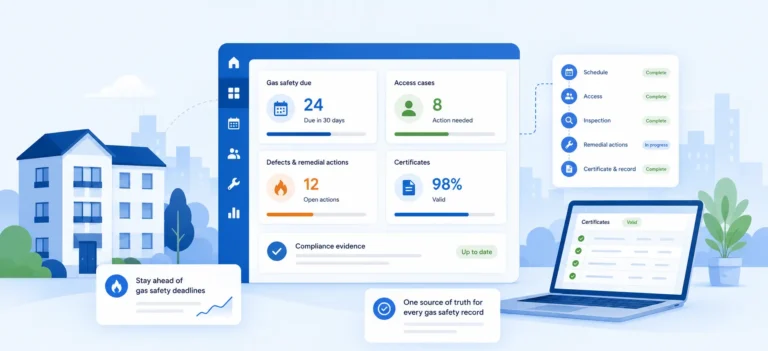
If you’re serious about getting and staying compliant under the Fire Safety Order, software might be able to help. You should check out True Compliance’s Fire Safety Compliance page for more information.