Key takeaways
- The Gas Safety (Installation and Use) Regulations 1998 (GSIUR) set the rules for safe installation, maintenance and use of gas systems, appliances, fittings and flues in Great Britain.
- They don’t just apply to “the contractor”. They place duties on anyone doing gas work, plus specific duties on landlords.
- Landlords must ensure safety checks happen on time, records are created and kept, and tenants receive the latest record within the required timeframes.
- Since April 2018, there’s a legal route to do checks up to two months early without resetting the annual deadline, if you follow the rules.
What are the Gas Safety (Installation and Use) Regulations 1998?
GSIUR is a UK statutory instrument that sets out safety requirements for gas fittings and appliances, covering everything from competence to pipework, to flues, to how appliances must be used. The Health and Safety Executive’s Approved Code of Practice and guidance (L56) is the plain-English companion that shows what “good” looks like in practice.
For most social landlords, the day-to-day impact sits in two places:
- who can do gas work (competence and registration)
- what you must do as a landlord (checks, records, and proof)
Who has duties under GSIUR?
GSIUR is not “landlord-only”. It places duties on:
- people carrying out gas work
- employers and self-employed people who control or require gas work
- landlords, through a dedicated set of obligations in Regulation 36
That matters in social housing because the organisation often wears more than one hat: landlord, client, contract manager, sometimes even employer.
Regulation 3: competence (the rule behind “Gas Safe only”)
Regulation 3 is simple in principle: no one should carry out gas work unless they are competent. It also places responsibilities on employers and others who control or require that work.
In practice, competence for most domestic gas work is evidenced through registration. HSE’s landlord guidance is clear: a Gas Safe registered engineer must fit and check gas appliances, and it isn’t acceptable for a registered engineer to “sign off” work done by someone who isn’t registered.
For contract management, it’s not enough to check the badge once. Engineers have work categories. Gas Safe provides guidance on staying within scope.
Regulation 36: the landlord’s obligations
Regulation 36 is the part most people mean when they say “gas safety regulations for landlords”.
Safety checks: at installation, then every 12 months
Landlords must ensure each relevant appliance and flue is checked for safety within 12 months of installation and then at intervals of no more than 12 months.
Records: what must be included, and how long you keep them
Regulation 36 specifies what the record must contain, including:
- date and property address
- landlord (or agent) details
- appliance/flue description and location
- any safety defects and remedial action
- confirmation that the check meets the regulation requirements
- engineer name, signature, and registration number
It also sets retention rules: keep records until there have been two further checks, or two years for an appliance/flue removed from the premises.
Issuing records to tenants: the deadlines people miss
Below is expectation the legislation has of the landlord:
- existing tenants receive the latest record within 28 days
- new tenants receive it before they move in
The “two months early” flexibility (and why it exists)
Since the 2018 amendment, landlords can have checks done up to two months before the deadline date and still keep the original annual cycle, as long as it’s done correctly. This is designed to reduce last-minute scrambles and access failures.
The parts outside Regulation 36 that still matter to landlords
Even if your contractors lead on technical detail, the broader regulations are still relevant because failures tend to show up as landlord risk.
L56 sets out how GSIUR covers gas fittings, meters, regulators, installation pipework, appliances and flues, plus requirements around safe installation and use.
This is where issues like incorrect flueing, poor ventilation, or unsafe pipe runs land. A missed defect in a check becomes a landlord problem when it sits in your stock.
What good looks like for social landlords
A decent programme is not paperwork-heavy. It’s repeatable and provable.
- Asset truth: you know exactly what appliances and flues are in each property and what you’re responsible for under the Regulation 36 definition of “relevant gas fitting”.
- Planned access: appointments are set early enough to use the two-month window where needed.
- Competence checks baked in: contractor and engineer registration is verified and scoped to the work.
- Evidence that stands up: records are complete, retrievable, and issued to tenants within the required timeframe.
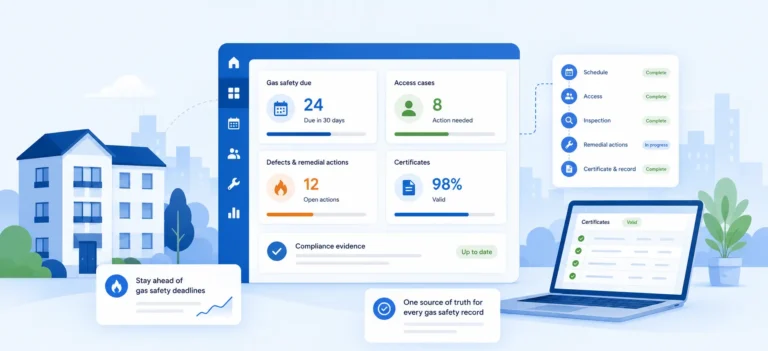
If you’re struggling with tracking and maintaining all of the information you need to stay on the right side of the gas compliance legislation, you might be interested in learning about True Compliance’s Gas Safety Compliance stream.