
For owners and managing agents of blocks of flats and other multi-occupied residential buildings, this has real consequences. It changes what you must consider, what you must record, and what you should be ready to show when an enforcing authority asks for evidence.
Key takeaways
- The Fire Safety Act 2021 clarifies that the Fire Safety Order applies to the structure, external walls (including cladding and balconies) and flat entrance doors in buildings with two or more domestic premises.
- The Act applies to England and Wales.
- Sections 1 and 3 commenced on 16 May 2022, alongside supporting guidance for prioritising FRA updates.
- You may not need to redo an FRA from scratch if it already meets requirements, but you may need to update it and consider whether a deeper external wall assessment is needed.
- In England, the Fire Safety Act sits alongside the Fire Safety (England) Regulations 2022 guidance, which adds practical duties like fire door checks and resident information.
What the Fire Safety Act 2021 actually changed
The Fire Safety Act 2021 is an amendment to the Regulatory Reform (Fire Safety) Order 2005 (the Fire Safety Order). It was introduced to remove ambiguity about what parts of certain residential buildings must be considered under fire safety law.
In plain terms: if your building contains two or more sets of domestic premises, the Act puts beyond doubt that the Fire Safety Order applies to the building’s structure, external walls and the doors between flats and common parts.
That sounds technical. The day-to-day impact is not. It means your fire risk assessment work has to be anchored in what’s true about the building, not just what’s visible on a corridor walk-through.
Who it affects (and where)
The Act applies to England and Wales. If you manage stock across the UK, it’s worth noting that Scotland and Northern Ireland have different fire safety legislation, so “UK-wide” compliance needs a jurisdiction view, not one template.
For England and Wales, the people who feel the impact are building owners, freeholders, managing agents and anyone who may be the “Responsible Person” under the Fire Safety Order for the parts of the premises they control.
The biggest change: what your fire risk assessment must cover
Before the Act, the Fire Safety Order already applied to common parts in blocks of flats. What changed is the forced clarity around scope.
Your FRA now needs to properly consider:
- Structure
- External walls, including cladding and balconies (and other attachments)
- Flat entrance doors that open onto common parts
You can read a bit more about this additional scope in the Fire Safety Act 2021 and in the NFCC FAQs.
Practical point: “in scope” does not mean “intrusive survey by default”
It’s not automatically necessary to redo an FRA if it already complies, and existing recent competent advice can be used to update it. Your assessor should be considering whether a more in-depth assessment of external walls is required.
So the job is to bring your FRA up to date in a way that matches the building’s risk profile, and to record why you’ve taken the approach you’ve taken.
External walls: what owners and managers should do now
External walls are where compliance becomes evidence-led, fast.
At a minimum, you should be able to pull together:
- what’s known about the external wall system (materials, attachments, changes over time)
- what’s unknown (gaps in as-built information, undocumented works)
- what controls exist (inspection regime, remedial works, interim measures where relevant)
- what the FRA concludes and what it recommends next
Where the FRA indicates it, you may need input from an appropriately competent professional for the external wall appraisal. That expectation is reflected in government guidance and echoed by fire and rescue service advice.
Flat entrance doors: treat them like a safety-critical asset
The Fire Safety Act makes it explicit that flat entrance doors between domestic premises and common parts sit within the Fire Safety Order’s scope for these buildings.
For owners and managers, that shifts doors from “reactive repairs” to “controlled inspection, repair, and record-keeping”:
- condition and self-closing function
- any damage or alterations
- defects logged, chased, closed, and rechecked
In England, your door compliance approach also needs to line up with the additional expectations in the Fire Safety (England) Regulations 2022 guidance.
What “Fire Safety Act compliance” looks like in an audit
Compliance is not just “we have an FRA”.
A solid position usually means you can produce, per building:
- the latest FRA, with clear scope and review trigger points
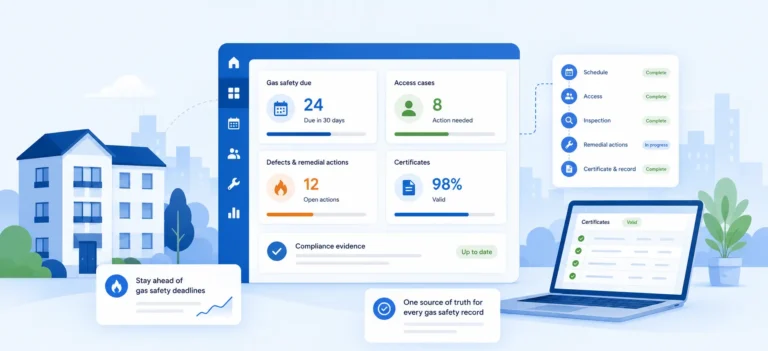
- a live action plan with owners, dates, and close-out evidence
- records that show how external wall information has been considered and kept current
- inspection and repair records for flat entrance doors (and communal doors where applicable)
- a documented rationale where you’ve decided a deeper external wall assessment is or is not needed
The Home Office’s Fire Safety Act commencement prioritisation guidance was published to support Responsible Persons in deciding which buildings should be updated first, and gives a good clue to how regulators will look at priorities and risk.
Common pitfalls (the stuff that causes pain later)
- Treating the Act as a paperwork change. It’s a scope and evidence change.
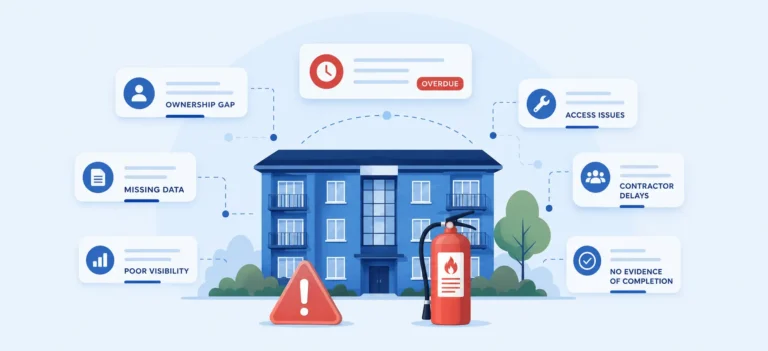
- Letting responsibility drift. In multi-stakeholder buildings, gaps appear where control is shared, and nobody owns the handover.
- Assuming “external walls” is a single tick-box. If your building’s history is messy, your evidence needs to be tidy.
- Fixing issues but not recording them. Repairs without records fail the “show me” test.
If you’re looking for software that can help keep you on the right side of fire compliance, you should check out True Compliance’s Fire Safety Compliance page.