
That’s why Gas Safe registered engineers matter. They’re not a nice-to-have. They’re part of what makes your gas safety duties defensible.
Key takeaways
- For rented homes in Great Britain, landlord gas safety checks and most gas work must be carried out by a Gas Safe registered engineer.
- Gas safety isn’t just “have a contractor”. Landlords still carry the duty to keep checks in place and up to date.
- “Registered” needs to match the right person, on the day, for the right type of work. Gas Safe registration is tied to categories of work.
- It’s not acceptable for a registered engineer to “sign off” on gas work done by someone unregistered. Both parties may face prosecution.
What “Gas Safe registered” actually means
Gas Safe Register is the official register for gas engineers in Great Britain. A registered business can only legally carry out gas work in the categories of work shown for that business and its listed engineers.
So “Gas Safe” is not one blanket badge. It’s permission to do specific kinds of gas work by specific people.
The legal link: competence and landlord duties
Two pieces sit underneath most landlord compliance conversations:
- Competence requirements for gas work under the Gas Safety (Installation and Use) Regulations 1998 and supporting guidance.
- Landlord duties for safety checks, maintenance and records, brought together in HSE’s landlord guidance.
Annual gas safety checks are part of a landlord’s responsibilities, and the “who can do it” answer comes back to Gas Safe registration.
Why it matters for compliance (not just safety)
1) The evidence trail depends on the engineer’s registration
Your Landlord Gas Safety Record needs the engineer’s details. If the engineer isn’t properly registered for the work, the paperwork stops being proof and starts being a liability.
2) You can’t outsource the duty
Gas Safe Register makes this point directly: registered engineers are not responsible for landlord gas safety checks being in place or up to date. The responsibility sits with the landlord.
That line matters in social housing, where compliance is often spread across contractors, supervisors, call centres, housing teams and record systems.
3) “Sign-off culture” creates real risk
HSE says it is not acceptable for a Gas Safe registered engineer to knowingly sign off work done by a non-registered person, and notes potential prosecution for both.
If you manage multiple contractors, that single sentence should shape your procurement checks and your site supervision.
How to check a Gas Safe engineer properly
A quick “yes, they’re Gas Safe” is not enough. Checking should be part of the appointment routine.
1) Check the business and the engineer
- Use Gas Safe Register’s “Check an engineer” to confirm the business is registered and to see the categories of work they can legally do.
- The government points people to Gas Safe’s tools for checking an engineer and confirming identity using the licence number on the ID card.
2) Check the scope matches the job
“Gas Safe registered” isn’t the same as “qualified for this appliance”. Gas Safe registration is issued with work categories, and those categories should match what you’re asking them to do.
“Gas Safe registered” isn’t the same as “qualified for this appliance”. Gas Safe registration is issued with work categories, and those categories should match what you’re asking them to do.
If you want a technical view on staying within work categories, the industry-facing guidance in Registered Gas Engineer Technical Bulletin 014(B) is a straightforward look at competence and staying within scope.
3) Make it easy for residents to challenge
Residents should expect to see an ID card and be comfortable asking questions. In social housing, that’s also a safeguarding win.
Residents should expect to see an ID card and be comfortable asking questions. In social housing, that’s also a safeguarding win.
Common traps that trip up landlord compliance
“The plumber did the boiler, the gas engineer signed it off.”
This is not acceptable where the gas work has been carried out by someone unregistered.
This is not acceptable where the gas work has been carried out by someone unregistered.
“The company is Gas Safe, so we’re covered.”
Registration has categories and individual engineers. If the wrong person turns up, or the work is outside scope, you’ve still got an exposure point.
Registration has categories and individual engineers. If the wrong person turns up, or the work is outside scope, you’ve still got an exposure point.
Subcontracting you can’t see.
If your contract chain gets long, your controls need to get tighter: who attended, what ID they held, what categories apply, and what they actually did.
If your contract chain gets long, your controls need to get tighter: who attended, what ID they held, what categories apply, and what they actually did.
A quick checklist for social landlords
- Every job that touches gas work is assigned to a Gas Safe-registered engineer with the right scope.
- Engineer identity and categories are checked using Gas Safe’s check tools and reflected in your job record.
- “Sign-off” arrangements are explicitly blocked in policy and contract wording.
- Your programme reflects the landlord reality: the duty stays with you.
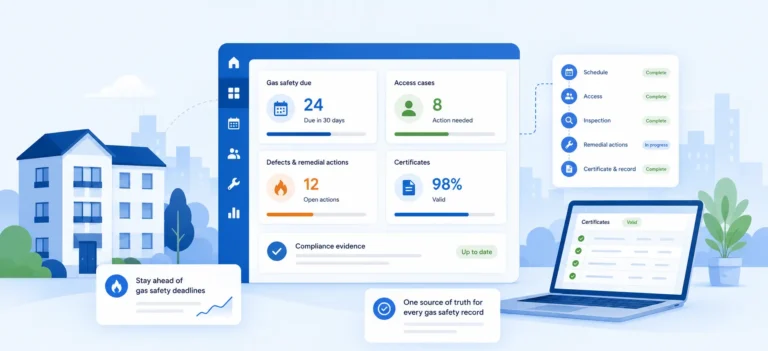
If you’re struggling to maintain your gas safety compliance, then you might need to look at software as a solution. You can check out True Compliance’s Gas Safety Compliance page for more information.