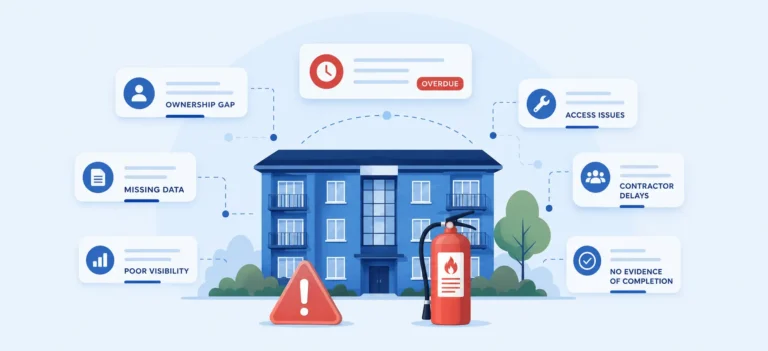

If you own or manage residential blocks, the shift is obvious: less reliance on judgment calls and legacy paperwork, more on defined roles, tracked decisions, and information that stays current.
Key takeaways
- The Building Safety Act 2022 received Royal Assent on 28 April 2022 and created the Building Safety Regulator (BSR) as part of the new regime.
- For occupied higher-risk buildings, the definition (in England) is broadly: at least 18m or 7 storeys and 2+ residential units, with certain exclusions where the entire building is a hospital, care home, hotel, secure residential institution, or military barracks.
- Accountable Persons and the Principal Accountable Person (PAP) manage fire and structural safety risks for high-rise residential buildings in England.
- The “golden thread” is a digital record of building information that supports legal duties and day-to-day safety management.
- Section 156 of the Act amended the Fire Safety Order and, from 1 October 2023, requires things like recording the full fire risk assessment, documenting fire safety arrangements, improving cooperation between dutyholders, and sharing key information in multi-occupied residential buildings.
Two changes, not one
The Building Safety Act is best understood as two related tracks:
Track A: A new regime for higher-risk buildings in occupation, overseen by the Building Safety Regulator, with defined dutyholders and a higher bar for demonstrating control of risk.
Track B: Direct changes to fire safety law via Section 156, which amends the Regulatory Reform (Fire Safety) Order 2005 and applies to Responsible Persons more broadly.
That’s why “fire safety compliance” now has two audiences: fire and rescue authorities enforcing fire safety law, and the BSR overseeing the higher-risk building regime.
Which buildings are caught by the higher-risk building rules?
For the in-occupation part of the regime (Part 4), a higher-risk building is, in broad terms, a building in England with at least 2 residential units and either 18 metres in height or 7 storeys.
The same guidance also lists key exclusions where the entire building is used as a hospital, care home, hotel, secure residential institution or military barracks.
If you manage mixed-use stock, don’t assume a “shop on the ground floor” changes anything. Mixed-use can still be in scope if the criteria are met.
New roles in occupied high-rise residential buildings: APs and the PAP
The Act introduced Accountable Persons (APs) and a single Principal Accountable Person (PAP) per building, with legal duties tied to the common parts and the structure and exterior.
APs and the PAP manage the building’s fire and structural safety risks, and the building must be registered with the BSR before people live there.
Where there are multiple APs, the PAP is usually whoever owns or is legally responsible for repairing the structure and exterior.
Registration, the safety case, and proving control
In the higher-risk building regime, “we manage risk” needs backing. The BSR’s guidance explains that the PAP can apply to register a building and provide information about the structure and fire safety, and can also tell the BSR when the safety case report is prepared or updated.
For day-to-day management, this documentation is written for Accountable Persons and is the closest thing to an “operating manual” for the in-occupation expectations.
The golden thread: the “single source of truth” expectation
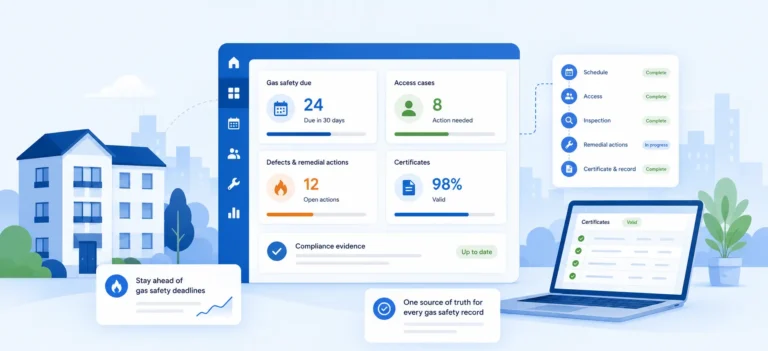
The golden thread isn’t a slogan. Dutyholders must keep a digital record of building information, stored securely, available when needed, and presented so someone can actually use it.
Crucially, regulators (including fire and rescue services and the BSR) also use that information. In other words: if your information is scattered, outdated, or locked in inboxes, it’s not just inefficient, it undermines compliance.
Mandatory Occurrence Reporting: learning from failures, not repeating them
During construction or building work on higher-risk buildings, principal designers and principal contractors must submit mandatory occurrence notices and reports to the BSR. That’s set out in this document.
This is part of the wider “no surprises” approach: issues that could affect building safety are meant to be flagged and recorded, not quietly patched over.
The Building Safety Act also changed fire safety law: Section 156
Section 156 matters even if you don’t manage a higher-risk building. There have been amendments to the Fire Safety Order, including requirements to:
- record the completed fire risk assessment in full
- record fire safety arrangements (how fire safety is managed)
- record and keep contact details up to date (including a UK-based address)
- take steps to identify other Responsible Persons and Accountable Persons and cooperate, including during handovers
- provide residents in multi-occupied residential buildings with relevant fire safety information in a format that’s easy to understand
This is the connective tissue between “fire safety” and “building safety”: clearer dutyholder links, better information flow, and a stronger expectation that safety records are complete, current, and shareable.
How this sits alongside the Fire Safety Act 2021 and Fire Safety Order
The Building Safety Act doesn’t replace fire safety law. Depending on the circumstances, dutyholders may still also be subject to the Fire Safety Order.
And for multi-occupied residential buildings, the Fire Safety Order scope includes the structure, external walls (including cladding and balconies) and flat entrance doors.
In England, the Fire Safety (England) Regulations also add practical duties such as routine fire door checks, covered in Fire Safety (England) Regulations 2022: fire doors.
A practical “what now” checklist for owners and managers
- Confirm whether each building is a higher-risk building in occupation using the criteria, not guesswork.
- Name the APs and the PAP and document why, using the BSR’s accountable persons guidance.
- Register high-rise residential buildings where required and make sure your building information is accurate.
- Build and maintain the golden thread as a controlled digital record, with version control and clear ownership.
- Bring fire safety records up to the Section 156 standard, including full FRA recording, fire safety arrangements, and resident information where required.
- Join up fire safety and building safety teams: the Responsible Person and the PAP cannot operate in silos in the same building.
If you’re struggling with fire compliance, especially with the golden thread of evidence, then software might be able to help you. For more information, check out True Compliance’s Fire Safety Compliance page.