
If you’re looking for electrical safety compliance penalties UK-wide, the headline is simple: the consequences vary by nation, but the direction of travel is the same. Paperwork matters. Deadlines matter. And if something is unsafe, the clock runs out fast.
Key takeaways
- In England, councils can issue financial penalties of up to £30,000 for breaches of the electrical safety duties.
- In Wales, failing to provide an electrical condition report can have a direct financial impact, including rent recovery issues highlighted by a High Court test case.
- In Scotland, tenants can apply to the Tribunal, which can order repairs and (in some situations) reduce rent; ignoring an enforcement order can become a criminal offence.
- In Northern Ireland, the 2024 regulations create offences for non-compliance, enforced by district councils, with fines set by reference to the standard scale.
- Enforcement often comes down to evidence: a valid report, proof you acted, and a clear audit trail.
England: civil penalties, remedial notices, and council-led works
In England, the enforcement route most landlords know is the Electrical Safety Standards in the Private Rented Sector (England) Regulations 2020. This has now been updated with changes that extend coverage into the social rented sector (see the latest electrical safety standards guidance).
If you fail the duties (inspection, reporting, completing remedial work), a local authority can issue a financial penalty. The legal cap is £30,000. That’s not a typo. Worse still, it can apply more than once where a failure continues.
Alongside penalties, councils can use a practical lever: if a landlord doesn’t act, the authority has powers to arrange remedial action and recover costs, depending on the circumstances (with processes and appeal routes set out in the regulations and guidance). The government’s guidance gives the plain-English version of how this tends to play out in real life.
It’s also worth remembering that electrical risk can trigger wider housing enforcement. Under the Housing Health and Safety Rating System (HHSRS), councils can take action where hazards are identified, including improvement notices, prohibition orders and emergency remedial action. Shelter’s professional guide summarises their main enforcement tools.
Wales: “fitness for human habitation” and rent consequences
Wales takes a slightly different route. Electrical safety sits inside the wider “fitness for human habitation” framework under Renting Homes.
What catches many landlords and housing providers isn’t the inspection itself, it’s the admin after it: providing the report to the contract-holder within the required timeframe. A Divisional High Court decision in Coastal Housing Group Ltd & Ors v Mitchell & Ors (Nov 2024, judgment discussed publicly in December 2024) has been widely reported as having serious implications for rent recovery where the electrical condition report isn’t provided correctly. See the commentary from Trowers & Hamlins on the test case and Cornerstone Barristers’ case note.
For the underlying duties and the “fitness” framework, Welsh Government guidance is the right place to start: Fitness of homes for human habitation: guidance for landlords.
The practical takeaway: in Wales, electrical compliance isn’t only about avoiding a fine. Poor process can hit income, disputes, and legal position.
Scotland: Tribunal enforcement, rent relief, and offences for ignoring orders
In Scotland, enforcement runs through the First-tier Tribunal for Scotland (Housing and Property Chamber). The Scottish Government’s statutory guidance outlines the route from tenant complaint to a Repairing Standard Enforcement Order (RSEO).
If a landlord doesn’t comply with an RSEO, the Tribunal can make a rent relief order, reducing the rent payable until compliance (see Housing (Scotland) Act 2006, section 27).
And ignoring an RSEO can also become a criminal matter: failing to comply “without reasonable excuse” is an offence (see Housing (Scotland) Act 2006, section 28).
Northern Ireland: offences, council enforcement, and fixed penalties
Northern Ireland’s position has changed quickly. The Electrical Safety Standards for Private Tenancies Regulations (Northern Ireland) 2024 came into operation on 1 April 2025 (as set out in the regulations PDF and departmental publications). The Department for Communities summarises the intent here.
The regulations create offences for failing to comply with the core duties, with liability on summary conviction to a fine not exceeding level 5 on the standard scale. See Regulation 12 for more details.
They also allow for fixed penalty options in some cases, described in the regulations’ explanatory material.
What enforcement usually looks like on the ground
Across the UK, enforcement tends to follow the same pattern:
- A trigger: tenant report, contractor flag, planned inspection, or a broader housing standards visit.
- A request for evidence: the latest electrical report, confirmation of remedial works, and proof that it was shared.
- A deadline: for works, for providing documents, or for responding to a notice.
- Escalation if you stall: penalties, orders, cost recovery, or restrictions that get increasingly expensive to unwind.
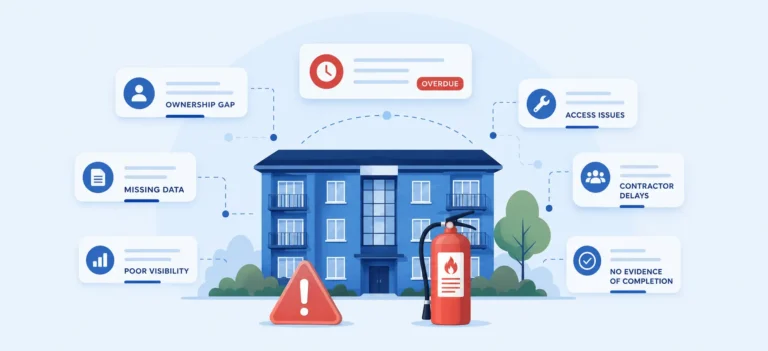
The frustrating part is that plenty of cases don’t start with a dangerous installation. They start with an organisation that can’t quickly prove what it did, when it did it, and who signed it off.
A simple way to stay out of enforcement territory
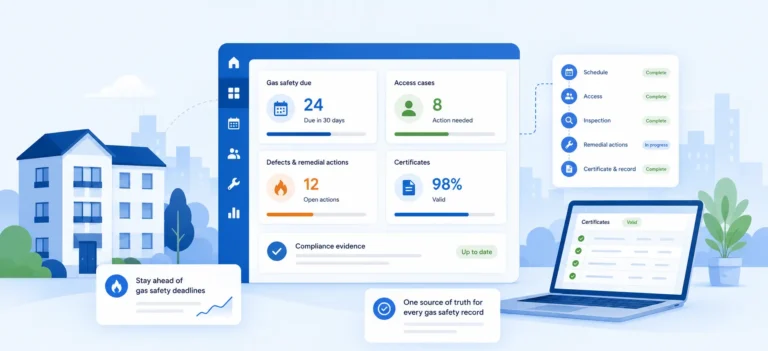
- Keep one live record per asset: latest report, next due date, remedial actions, completion evidence.
- Treat “share the report” as a task with an owner, not an afterthought.
- If access is the blocker, document every attempt and keep alternatives ready.
- Where urgent hazards are flagged, move fast and keep proof of completion.
If you’re worried about enforcement, it would be very sensible to take a look at a compliance software that can hold all of your certificates and proof of work in one place. If this is of interest, check out True Compliance’s Electrical Safety Compliance page.