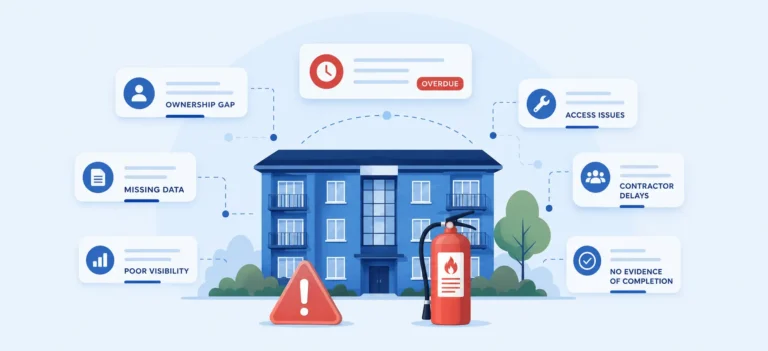

In UK property insurance, the fallout from non-compliance usually lands in three places: claims, cover, and cost. And for landlords, councils and housing associations, the pressure is higher because you’re dealing with shared spaces, higher footfall, and more third-party exposure.
Key takeaways
- You have to give insurers a fair presentation of risk with the Insurance Act 2015 duty of fair presentation applying to most commercial policies.
- For “qualifying breaches”, insurers can apply remedies set out in the Insurance Act 2015 Schedule 1, including avoidance and proportionate claim reduction.
- Breach of a notification clause framed as a “condition precedent” can mean a claim is declined, even when the underlying incident is covered.
- Breach of warranty can suspend cover for losses happening during the breach window, even if you fix it later.
- Insurers often ask for evidence around safety-critical systems (fire and lifts are common).
What “failing insurance compliance” actually means
Most issues fall into one (or more) of these buckets:
- Disclosure failures at placement or renewal
If material facts aren’t disclosed clearly, you’re into “fair presentation” territory under the Insurance Act. - Breach of policy terms
That might be a warranty, a condition, or a specific risk requirement (for example, maintaining protections, completing inspections, following a survey action plan). - Claims process failures
Late notification, incomplete notifications, or missing paperwork. These are where “condition precedent” clauses often bite.
The real-world consequences in the UK
Your claim can be reduced, reshaped, or refused
If an insurer can demonstrate that, but for a breach of fair presentation, it wouldn’t have written the policy (or would have written it on different terms), it is entitled to remedies under the Act.
Schedule 1 lays out outcomes such as:
- Avoidance and refusal of claims for deliberate or reckless breach, with no return of premium in that scenario.
- For other breaches, remedies can include treating the contract as if it had different terms from the outset, or reducing the claim proportionately if the premium would have been higher.
That’s not theory. It’s the legal framework insurers reach for when disclosure and risk controls don’t match.
A single missed deadline can sink an otherwise valid claim
Notification clauses are a repeat offender in claim disputes. Where worded as a condition precedent, breach can allow an insurer to decline the claim.
Courts continue to treat notification language seriously. CMS flagged a recent decision where wording operated as a condition precedent, allowing the insurer to refuse indemnity.
Cover can be “off” while you’re in breach of warranty
The Insurance Act changed the old “one breach kills the policy” approach for warranties, but it didn’t remove the sting.
Section 10 (as discussed in current legal commentary) means insurers can have no liability for losses occurring after a warranty is breached but before it’s remedied.
And section 11 limits insurers relying on breaches that couldn’t have increased the risk of the loss that actually happened, which helps in edge cases, but it won’t save you from a breach that’s connected to the claim.
You can end up “subject to survey”, with tighter terms and more scrutiny
Insurers use surveys to test risk controls and evidence. Marsh describes how a property risk evaluation produces a report for underwriters, including a prioritised action plan of recommendations that the organisation agrees to implement.
If you can’t show control, expect more questions at renewal, more conditions, and less room to negotiate.
Where social housing portfolios get caught out
Fire: duties exist, but evidence wins or loses the argument
For blocks with communal areas, the Fire Safety (England) Regulations 2022 created additional duties from 23 January 2023, on top of the Fire Safety Order framework.
Insurers don’t just ask “do you have an FRA?” They ask whether actions are tracked, completed, and evidenced. The Home Office guide for dutyholders is useful for sanity-checking what you should be able to show.
Lifts and lifting: easy to check, hard to blag
Lifts provided for use in work activities must be thoroughly examined by a competent person at regular intervals under LOLER. And even where lifts are used primarily by the public, the guidance can help dutyholders meet broader duties, and insurers may still demand stringent risk management for public liability.
How to reduce the fallout
- Build a renewal pack that’s “clear and accessible”, not a file dump.
- Treat notification like a clock, not a checkbox. If your policy sets a trigger, hit it, and keep a record of when you did.
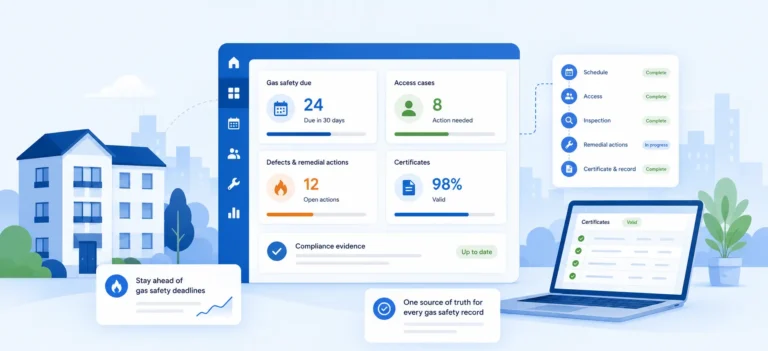
- For inspections and remedials, aim for one audit trail: asset list, due dates, certificates, defects, close-out evidence.
If you’re struggling with insurance compliance, it might be worth looking at how software could help you to better manage it. You can check out True Compliance’s insurance inspections compliance page for a bit more information.