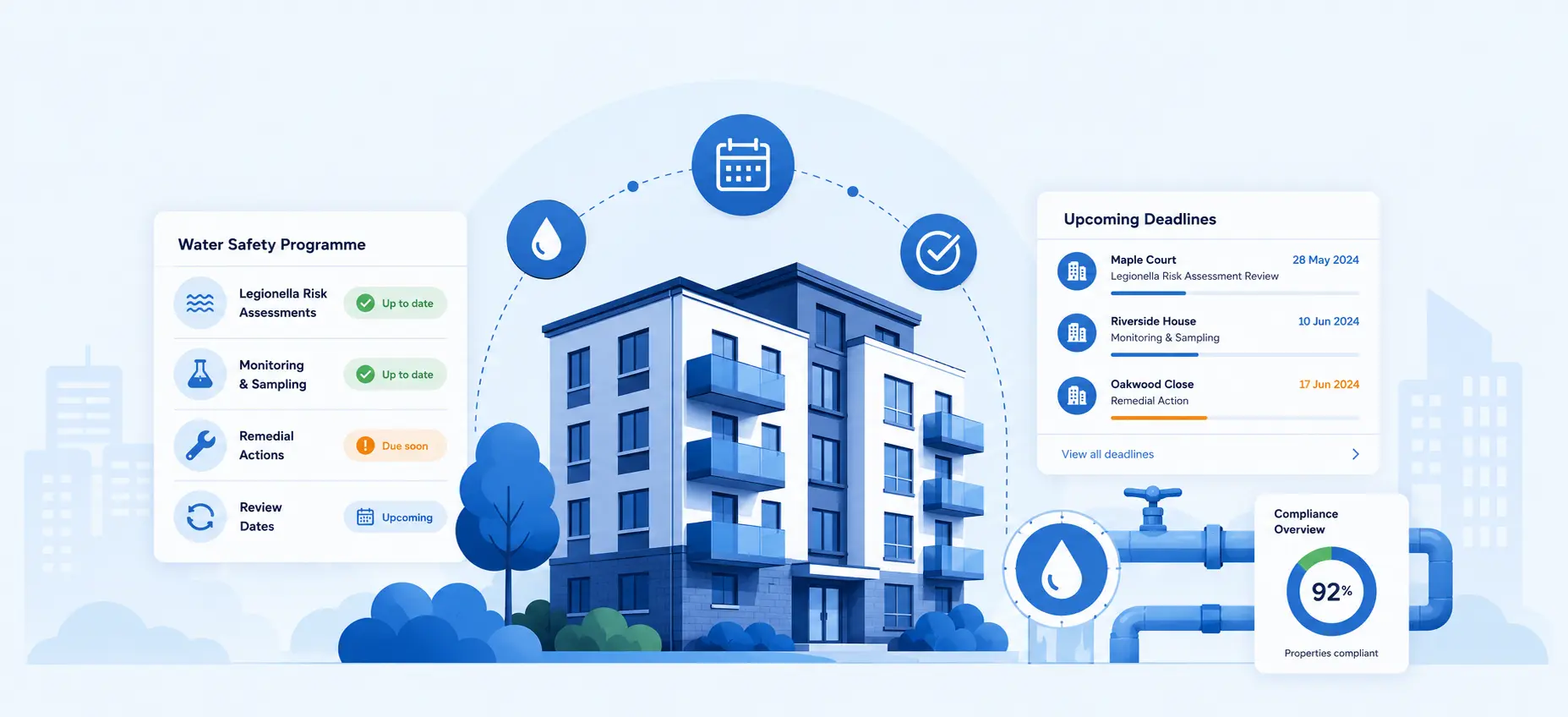
Tracking water safety deadlines is not as simple as adding an annual “Legionella inspection” to the compliance calendar. The law does not prescribe a universal annual or biennial review date for every domestic water system, and routine Legionella sampling is not normally required in ordinary domestic properties.
The deadlines you need to control come from several places: the Legionella risk assessment, the written control scheme, technical guidance, equipment instructions, remedial recommendations and changes affecting the building or its residents. Across a housing portfolio, the awkward part is rarely identifying one date. It is keeping every recurring task, review trigger and corrective action connected to the right property and water system.
This article primarily covers landlords in Great Britain. Northern Ireland has a separate legislative framework, including the Health and Safety at Work (Northern Ireland) Order 1978 and the Control of Substances Hazardous to Health Regulations (Northern Ireland) 2003.
Key takeaways
- There is no blanket legal requirement to renew every domestic Legionella risk assessment annually.
- Monitoring frequencies should be taken from the risk assessment and written control scheme for each water system.
- HSE guidance provides indicative frequencies for common controls, but these are not a substitute for a system-specific assessment.
- Changes, failed checks and periods of low occupancy can create deadlines outside the normal calendar.
- A completed visit is not the same as a controlled risk. Remedial work must be assigned, completed and verified.
- Your records should show what was due, what happened, who reviewed the result and how any exception was resolved.
What the law expects housing providers to control
In Great Britain, duties relating to Legionella arise principally through the Health and Safety at Work etc. Act 1974, the Control of Substances Hazardous to Health Regulations 2002 and the Management of Health and Safety at Work Regulations 1999. Together, they require dutyholders to assess foreseeable risks and take suitable precautions to prevent or control exposure.
The Health and Safety Executive’s Approved Code of Practice L8 explains the management framework. It covers risk assessment, the appointment of a competent responsible person, implementation of a control scheme, monitoring and record keeping. HSG274 Part 2 provides supporting technical guidance for hot and cold water systems.
For registered providers in England, the Regulator of Social Housing’s Safety and Quality Standard adds an important assurance requirement. Providers must identify and meet relevant health and safety legal requirements, maintain accurate property-level information and complete actions arising from legally required assessments within appropriate timescales.
Which water safety deadlines should you track?
For simple domestic systems, the assessment may conclude that proportionate controls and periodic review are sufficient. HSE confirms that there is no prescribed annual or biennial review cycle and no legal requirement for landlords to obtain a “Legionella test certificate”.
Larger blocks, supported housing, communal systems and buildings with stored or recirculating water will usually generate more frequent tasks. HSG274 gives the following indicative frequencies, subject to the findings of the risk assessment:
| Control | Typical frequency in HSE guidance |
| Sentinel hot-water temperature checks | Monthly |
| Sentinel cold-water temperature checks | Monthly |
| Subordinate hot-water loop checks | Quarterly, ideally on a rolling monthly programme |
| Cleaning and descaling showers and spray taps | Quarterly, or more frequently where risk indicates |
| Cold-water storage tank inspection | Annually |
| Internal calorifier inspection and cleaning | Annually, or according to fouling |
| Flushing outlets affected by low use or non-occupancy | Usually at least weekly |
These frequencies are starting points, not universal statutory deadlines. HSG274 states that the inspection and monitoring schedule should reflect the system’s complexity, building use and susceptibility of the people who may be exposed.
Build one live register of systems and obligations
Deadline tracking should begin with the water system, not the contractor’s appointment diary. Your register should identify:
- the property, block and individual water system
- whether the system is simple, stored, communal or recirculating
- the current risk assessment and its review arrangements
- the responsible person and operational task owner
- every monitoring, inspection and maintenance requirement
- the frequency, last completion date and next due date
- applicable control limits, such as temperature parameters
- open recommendations, target dates and escalation status
- evidence showing completion and verified closure
A property-level record also needs to distinguish between landlord-controlled communal assets and installations within individual homes. Without that distinction, teams can either miss a shared system or schedule unnecessary work against a low-risk domestic installation.
Separate recurring, triggered and remedial deadlines
Putting every task into one undifferentiated list makes it difficult to see why it exists. A workable process uses three deadline types.
Recurring deadlines
These include temperature monitoring, flushing, outlet cleaning, tank inspections and planned maintenance. The next date should be calculated from the required frequency and confirmed completion date, rather than from the date an invoice was received or uploaded.
Event-triggered reviews
A risk assessment should be reviewed when there is reason to suspect it is no longer valid. Triggers may include:
- alterations to the water system
- refurbishment or a change in building use
- extended void or low-occupancy periods
- changes affecting susceptible residents
- repeated temperature failures
- new information about the system or control measures
- changes to key personnel
- a suspected or confirmed case associated with the system
HSE describes risk assessment as an ongoing process and expects review arrangements and triggers to be recorded.
Remedial deadlines
Every failed control or risk assessment recommendation should become a traceable action with a named owner, risk-based target date and escalation route. The original check should remain open until the corrective work has been completed and its effectiveness verified.
That distinction matters. Replacing a valve may complete the repair order, but the water safety action is not closed until the relevant temperature, flow or system condition has been rechecked.
Build escalation into the calendar
A reminder on the due date is usually too late. Use look-ahead periods that reflect access requirements, contractor capacity and the consequence of failure.
For example, an annual tank inspection may need alerts 60, 30 and 14 days before its deadline, while a missed weekly flushing task may require escalation on the same day. Failed temperature readings should create an immediate exception rather than waiting for the next monthly visit.
No-access cases also need a controlled status. Record each attempt, the communication with the resident, the assessed risk and the next action. Moving the date forward without documenting the decision produces a tidy dashboard but a weak evidence trail.
Keep evidence connected to the deadline
A defensible record should show:
- What task was required and why.
- When and where it was completed.
- Who completed it and whether they were competent.
- The result, including readings or observations.
- Any departure from the required control limit.
- The corrective action and target date.
- The evidence used to verify closure.
HSG274 advises keeping risk assessment and control records while they remain current and for at least two years afterwards. Monitoring and inspection records should generally be retained for at least five years.
A practical assurance test
A water safety programme is under control when you can produce a current record for every relevant system, explain how each next due date was calculated and show that failed checks lead to completed and verified action.
The inspection is only the start. The stronger test is whether properties, systems, contractors, dates and remedials remain connected from assessment through to close-out.
For housing providers reviewing how this evidence is managed across their portfolio, the True Compliance water quality platform supports the allocation of assessment actions, calculation of next due dates and recording of completion evidence.