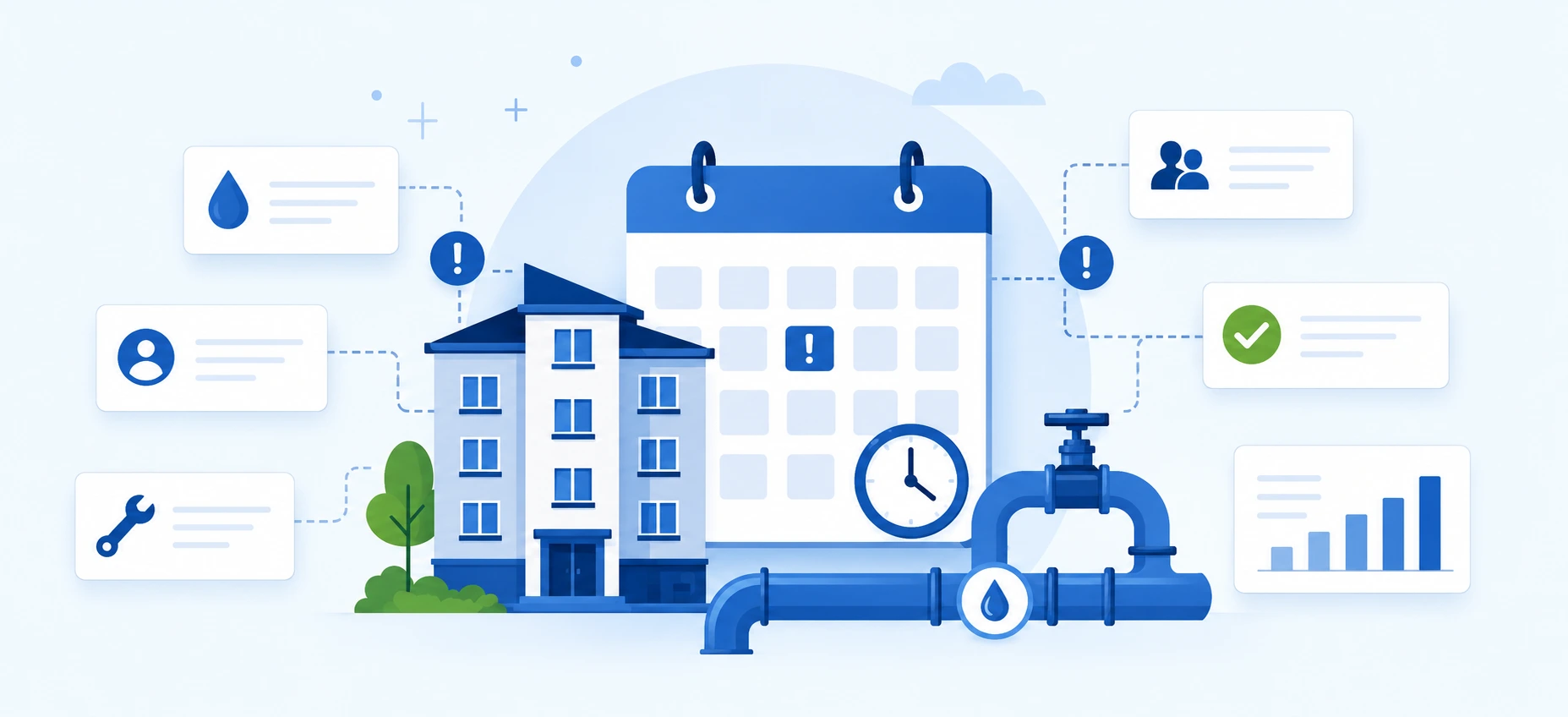
That distinction matters. Water safety is not a single annual inspection programme. It includes risk assessments, monitoring, flushing, temperature checks, cleaning, maintenance, remedial work and reviews triggered by changes to a building or its occupants.
The awkward part is rarely identifying another deadline. It is maintaining control when hundreds or thousands of deadlines behave differently.
This article focuses on the legionella control framework applying in Great Britain and the regulatory expectations placed on registered social landlords in England. It provides general information, not legal advice.
Key takeaways
- Water safety deadlines should reflect the system and its risks, rather than being forced into one portfolio-wide cycle.
- A completed contractor visit does not necessarily mean the compliance action has been completed.
- Property changes, void periods, low-use outlets and vulnerable residents can create new actions outside the routine programme.
- Every failed check or overdue visit needs an owner, an escalation route and a defined close-out requirement.
- Reliable assurance depends on linking dates, results, defects, remedial actions and evidence at property or asset level.
- A deadline process is only effective when exceptions become visible early enough for someone to intervene.
Water safety does not run on one calendar
Under the Health and Safety at Work etc. Act 1974 and the Control of Substances Hazardous to Health Regulations 2002, landlords and others in control of premises must assess and control foreseeable risks from exposure to legionella.
The Health and Safety Executive’s Approved Code of Practice L8 and technical guidance HSG274 explain how those duties should be managed in practice. These documents provide authoritative guidance on compliance, but they are not themselves Acts of Parliament.
This does not produce one universal deadline for every home, block or water system. The frequency of inspection and maintenance depends on the system and the risks it presents, and the findings must be recorded. Risk assessments should also be reviewed when significant changes occur, such as alterations to a water system or changes in the resident population, as explained in the HSE’s guidance on controlling legionella in hot and cold water systems.
For a housing provider, the compliance calendar may therefore include:
- scheduled risk assessment reviews
- routine temperature and condition monitoring
- flushing of infrequently used outlets
- inspections of tanks, calorifiers and other assets
- cleaning and disinfection
- investigation of failed control parameters
- remedial actions identified through assessments or monitoring
- reviews after refurbishment, changes in use or extended vacancy
Each activity may have a different frequency, trigger and evidence requirement. Trying to manage all of them as variations of an “annual certificate” creates gaps almost immediately.
The common reasons deadlines become overdue
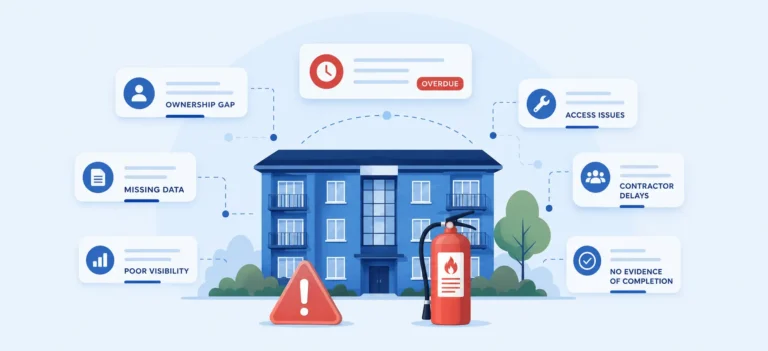
The property and asset data are incomplete
A deadline can only be managed when the organisation knows what is in scope.
Housing portfolios change continuously. Properties are acquired or disposed of, communal facilities are altered, outlets are removed and buildings move between operational teams. A water asset may exist in a contractor’s survey but not in the landlord’s asset register, while another may remain on the programme long after removal.
These are not minor administrative discrepancies. They determine whether a task is generated at all.
The Regulator of Social Housing’s Safety and Quality Standard requires registered providers in England to maintain an accurate, up-to-date and evidenced understanding of their homes, including accurate information at individual property level.
Routine dates are separated from risk assessment actions
Many systems handle recurring inspections reasonably well. The greater weakness appears when a risk assessment produces a one-off recommendation.
An assessment may require dead-leg removal, tank repairs, improved access, changes to monitoring locations or investigation of poor temperatures. These actions often pass into repairs, planned works or contractor systems where they lose their connection to the original water safety risk.
The assessment is recorded as complete, but the risk it identified remains open.
Contractor attendance is treated as completion
A visit can take place without producing a compliant outcome. The operative may be unable to gain access, inspect the relevant asset or complete all required checks. A report may arrive late, contain unclear results or identify a failure requiring further work.
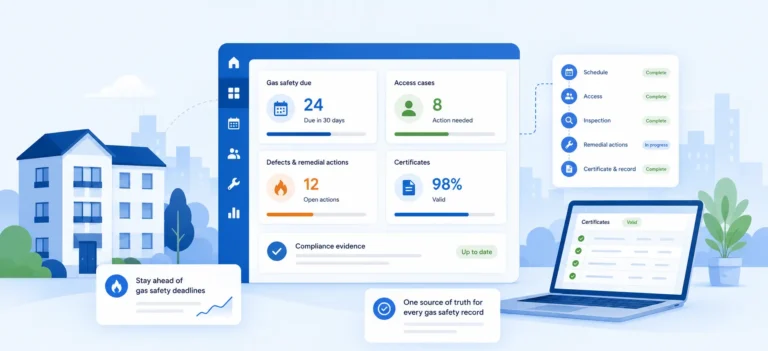
A robust process distinguishes between:
- appointment booked
- contractor attended
- inspection completed
- report received and validated
- defect assessed
- remedial work completed
- evidence checked
- action formally closed
Collapsing these stages into one “complete” status makes overdue risks difficult to see.
Access failures have no controlled next step
Access is a predictable feature of housing operations, not an exceptional event. Residents may not be available, plant rooms may require another team’s key or a contractor may discover that the recorded access instructions are wrong.
The first missed appointment is not necessarily the compliance failure. The failure develops when there is no defined rebooking period, escalation threshold or alternative method of gaining access.
The deadline process should state what happens after each failed attempt, who becomes involved and when the case must be escalated based on risk.
Changes do not trigger a review
Routine programmes tend to work from known dates. Water risks can also change between those dates.
A property may become vacant, an outlet may stop being used, a refurbishment may alter pipework or a resident with greater susceptibility may move into a building. The HSE’s guidance for landlords explains that assessments should be reviewed following significant changes and that stagnant or infrequently used sections of a system need to be considered.
Unless housing, voids, development and repairs teams can trigger the water safety process, the compliance team may not learn about the change until the next scheduled review.
Ownership is split across several teams
Water safety often crosses compliance, assets, repairs, housing management, development and contractor management. Each team may complete its own part correctly while assuming another team owns the next step.
The process needs one accountable owner for the overall control scheme, supported by named owners for individual tasks. Shared responsibility without clear accountability is usually just an orderly way of losing an action.
A completed deadline needs evidence and follow-through
The HSE’s record-keeping guidance states that dutyholders should keep information including responsible persons, significant risk assessment findings, the written control scheme, monitoring results and the dates on which checks were carried out. Monitoring records should generally be retained for at least five years.
For each property or system, a defensible record should show:
- what task was required and why
- the applicable due date or trigger
- who was responsible for arranging and completing it
- whether access was achieved
- the inspection, monitoring or test result
- any defect, failed parameter or recommendation
- the priority and target date for remedial action
- evidence of completion and verification
- who approved closure
The record should tell a coherent story. Someone reviewing it should not have to search several systems and an email inbox to establish whether the risk remains under control.
How to build a deadline process that holds up
Start with scope, not schedules
Confirm which properties, communal areas, water systems and assets require control. Reconcile risk assessments, asset records, contractor lists and housing data, then resolve gaps rather than simply choosing the most convenient source.
Record both recurring dates and event triggers
Scheduled monitoring is only part of the process. Define events that should prompt reassessment or action, including voids, refurbishment, system alterations, prolonged low use and relevant changes in occupancy.
Give every exception a next action
A failed temperature check, access problem or missing report should create a controlled workflow. It needs an owner, target date, escalation point and closure standard.
Monitor the gap before the deadline
Reporting only overdue work explains what has already gone wrong. Effective exception reporting also shows work approaching its due date, repeat access failures, reports awaiting validation and remedial actions at risk of delay.
Test the whole evidence trail
Sample cases from beginning to end. Select a property and ask whether you can produce the current assessment, monitoring history, outstanding actions, completed remedials and approval of closure.
Then select an overdue case and establish exactly when it became visible, who owned it and what happened next.
The practical assurance test
The Regulator of Social Housing’s Safety and Quality Standard requires registered providers in England to identify and meet relevant health and safety legal requirements. Providers must also ensure that actions arising from legally required assessments are completed within appropriate timescales.
The board does not only need to know how many visits took place. It needs assurance that the correct properties were included, deadlines reflected the actual risks, failed controls were escalated and remedial actions were verified.
A workable water safety process should answer four questions without delay:
- What is due?
- What has failed or become overdue?
- Who owns the next action?
- Can we prove the risk was brought back under control?
When those answers depend on spreadsheets being reconciled, contractors being chased or individual colleagues remembering the history, the deadline is not yet under control.