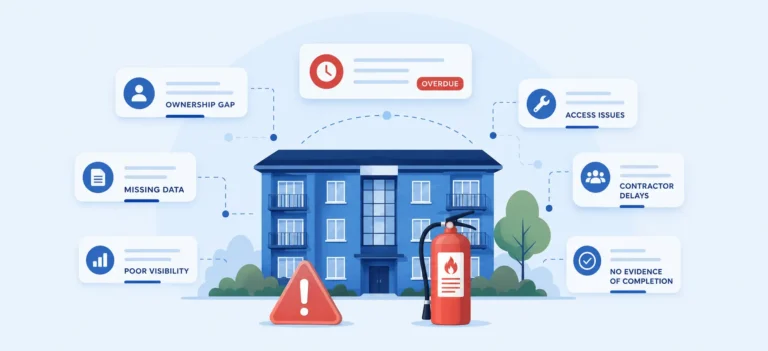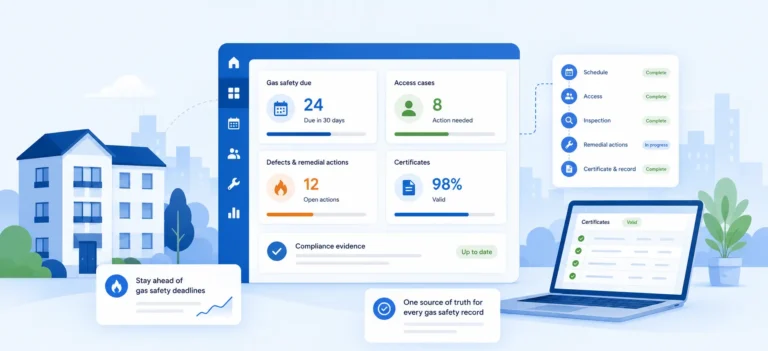

When that chain breaks, the consequences aren’t limited to remedial works and awkward emails. In the UK, failures can result in enforcement notices, cost recovery, prosecutions, civil penalties, and, in the most severe cases, life-changing consequences for residents and staff.
Key takeaways
- Water safety failures can lead to criminal enforcement under health and safety law, resulting in unlimited fines and, in serious cases, custody for individuals.
- The HSE can serve improvement notices and prohibition notices. A prohibition notice can bite immediately where there’s a risk of serious personal injury.
- Ignoring an HSE notice is not just “non-compliance”, it’s an offence in its own right.
- Local authorities can enforce housing hazards, including hygiene, sanitation, and water supply hazards. Failure to comply with an improvement notice is an offence.
- Civil penalties for certain housing offences have been up to £30,000, with an increase to £40,000 set to take effect from 1 May 2026 for specified offences.
Which laws are usually in play for water safety?
Most “water safety” enforcement in buildings connects back to health and safety duties, especially around legionella risk management. The Control of Substances Hazardous to Health Regulations (COSHH) provides the framework for controlling legionella risks.
That matters because enforcement doesn’t rely on a single “water safety certificate”. It relies on whether you did what the law expects of a dutyholder: assess risks, put controls in place, maintain them, and keep records.
Enforcement notices: improvement notices and prohibition notices
The HSE can require action formally through notices.
- An improvement notice is used where there’s a legal contravention that’s likely to continue or be repeated. It doesn’t need “serious risk” to be used, and it generally takes effect on a specified date, not earlier than 21 days after issue.
- A prohibition notice is about a serious risk. It can take effect immediately, stopping an activity where there is (or will be) a risk of serious personal injury.
The point isn’t the label. The point is that notices create a deadline and a paper trail. If you’re relying on “we told the contractor”, a notice forces you into naming owners, providing evidence, and dealing with close-out.
Ignoring a notice is itself an offence. The Health and Safety at Work etc. Act 1974 lists contravening an improvement notice or prohibition notice as an offence.
Fee for Intervention: paying for the regulator’s time
Even before you get anywhere near court, there’s a cost that many teams forget.
If the HSE visits and decides you’re in material breach of health and safety law, you can be charged for the time it takes them to identify what’s wrong and to help you put it right. This is the HSE’s Fee for Intervention (FFI) scheme.
It’s not a fine. It’s cost recovery. But it still hits budgets, and it still lands on the same people trying to keep services running.
Prosecution: unlimited fines and custody for individuals
Where the facts justify it, enforcement can move beyond notices into prosecution.
The Sentencing Council’s definitive guideline for health and safety offences sets out the maximum penalties and the way courts calculate fines. For organisations prosecuted for breach of duty under the Health and Safety at Work Act 1974, the guideline notes unlimited fines in both summary and indictment routes, with offence ranges that can reach multi-million pound levels depending on harm and culpability.
For individuals, the same guideline sets out that, when tried on indictment, the maximum can be an unlimited fine and/or up to 2 years’ custody, and when tried summarily, an unlimited fine and/or up to 6 months’ custody (depending on the offence and route).
This is where “we’ve always done it this way” stops being an internal debate. Courts look at what was foreseeable, whether warnings were ignored, and whether failures were systemic.
Corporate manslaughter: when a failure leads to death
This is the uncomfortable section, but it’s part of the legal landscape.
For corporate manslaughter offences, the Sentencing Council guideline states a maximum of an unlimited fine and gives an offence range that can reach very high levels.
No one sets out to end up here. The route is usually known risks, weak follow-up, poor recordkeeping, and actions that drift.
Personal consequences: disqualification and remedial orders
Where there’s a conviction, courts may also look at what needs to change, not just what needs to be paid.
The sentencing guideline highlights director disqualification as an ancillary order option, and points to the Company Directors Disqualification Act 1986, including that disqualification can last up to 15 years in the Crown Court.
It also references remedial orders, which can require an offender to take steps to remedy matters leading to the offence.
Housing enforcement: local authority action and civil penalties
For social landlords and housing providers, there’s also the housing conditions route.
Under the Housing Health and Safety Rating System (HHSRS), local authorities can take action on a range of hazards, including hygiene, sanitation and water supply hazards.
If an improvement notice is served under the Housing Act 2004 and becomes operative, failing to comply is an offence.
Separately, central government guidance confirms local authorities can impose civil penalties up to £30,000 as an alternative to prosecution for certain Housing Act 2004 offences, and that civil penalties came into force from 6 April 2017.
More recently, government guidance states that the maximum financial penalty for specified offences will increase from £30,000 to £40,000 from 1 May 2026.
More recently, government guidance states that the maximum financial penalty for specified offences will increase from £30,000 to £40,000 from 1 May 2026.
The “hidden penalty”: public records and lasting scrutiny
Enforcement action can follow you around.
The HSE publishes a public register of enforcement notices and states notices appear on the database for five years (published after a short delay to allow for appeals and checks).
For housing providers, public enforcement records can become part of procurement due diligence, governance conversations, and erode resident trust, long after the immediate works are done.
How to reduce legal exposure (without drowning in admin)
Most water safety failures come from the same few gaps:
- Risk assessments exist, but aren’t kept live (actions not closed, controls not checked).
- Ownership is unclear between the landlord, managing agent, and contractor.
- “Completed” means “someone said so” and not “evidence logged and verified”.
A simple rule that holds up in audits and investigations: every risk needs a control, every control needs a record, and every exception needs an escalation trail.
If you’re struggling to maintain full water safety compliance, then it might be time to look at how software can help. You can check out True Compliance’s page on Water Quality Compliance for more information.
General information only, not legal advice. If you’re dealing with an incident or enforcement action, get specialist legal guidance for your facts and location.