Manual gas safety processes are not automatically non-compliant. A well-managed spreadsheet, a disciplined team and clear procedures can meet the legal requirements.
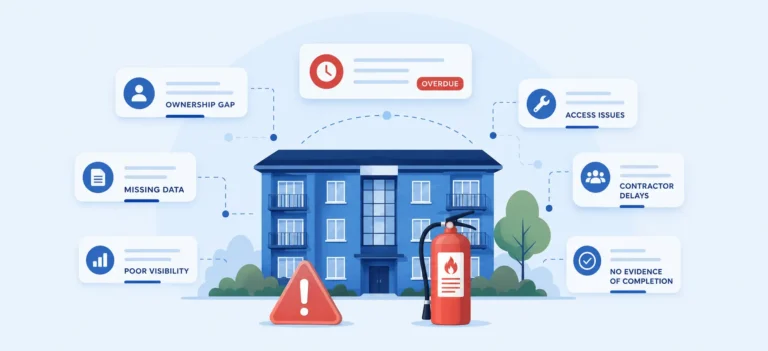
The difficulty is keeping that arrangement reliable across hundreds or thousands of homes, particularly when property data changes, residents do not provide access, contractors submit incomplete records or remedial work sits outside the main compliance tracker.
In 2026, the practical test is not whether your team has completed a large number of visits. It is whether you can show that every property in scope has been identified, every check was completed on time, every defect was followed through and every record can be produced under scrutiny.
This article focuses primarily on landlords in Great Britain. Northern Ireland has separate requirements under the Gas Safety (Installation and Use) Regulations (Northern Ireland) 2004.
Key takeaways
- The legal check remains only one part of gas safety control. Maintenance, access, records, defects and resident communication also need to be managed.
- Manual trackers become vulnerable when due dates, certificates and remedial actions are held in different places.
- The property and appliance register should be treated as controlled compliance data, not a list updated only before an audit.
- A completed certificate must not close the process automatically when defects or follow-up work remain outstanding.
- Effective assurance focuses on exceptions, including approaching deadlines, failed access, rejected records and overdue actions.
What the law requires in 2026
Under Regulation 36 of the Gas Safety (Installation and Use) Regulations 1998, landlords in Great Britain must ensure that relevant gas appliances and flues are checked within 12 months of installation and at intervals of no more than 12 months afterwards.
The check must be carried out by a suitably registered engineer. The landlord must also maintain the gas pipework, appliances and flues it provides for residents’ use. An annual check does not replace that wider maintenance duty.
The 2018 amendment to the Regulations allows a check to be completed during the two months before its deadline while retaining the original renewal date. This “MOT-style” flexibility provides useful operating space, but landlords must retain enough evidence to demonstrate that the timing rules were followed.
Existing residents must receive a copy of the Landlord Gas Safety Record within 28 days of the check. New residents must receive a current copy before moving in. Records must generally be retained for at least two years, with additional retention requirements applying when the early-check flexibility is used.
For registered providers in England, the Regulator of Social Housing’s Safety and Quality Standard also requires an accurate, current and evidenced understanding of property condition. Providers must identify relevant health and safety requirements and complete actions arising from legally required assessments within appropriate timescales.
Where manual processes usually develop gaps
The property register falls out of step
A gas programme can only be complete if the underlying property data is complete.
Properties may be missed when homes are acquired, converted, transferred, returned from lease, brought back into use or moved between management arrangements. Appliance replacements and changes to communal systems can create similar gaps.
A manual reconciliation completed once a year is not enough. The gas register should receive controlled updates from lettings, voids, development, acquisitions, disposals and asset-management processes.
Due dates are calculated inconsistently
Spreadsheet formulas and manually entered dates can create several versions of the same deadline. Problems also arise when teams use the completion date rather than the retained deadline permitted by the MOT-style process.
Fix this by defining one rule for calculating the statutory deadline, the appointment window and internal escalation dates. These dates should be generated consistently and protected from informal alteration.
Every change should leave an audit trail showing what changed, who approved it and why.
Access attempts are stored separately
Access is often the awkward part, not the inspection itself.
HSE guidance says landlords must take all reasonable steps to complete the work and should retain records of correspondence with residents. This may include notices of attempted visits, written explanations of the legal requirement and opportunities for residents to arrange suitable appointments. Landlords must not use force to enter a property.
A workable access process should record:
- each contact and attempted visit
- the method, date and outcome
- reasonable adjustments or support needs
- the next action and named owner
- the point at which legal or management escalation is required
Storing letters in one system and appointment outcomes in another makes it difficult to demonstrate the full sequence later.
Records are accepted without validation
Receiving a certificate is not the same as validating it.
Each Landlord Gas Safety Record should be checked against the property, appliances and engineer details. The record should contain the check date, property address, appliance and flue details, identified defects, remedial action, engineer identification and confirmation that the required checks were completed.
A proportionate validation process should flag:
- an incorrect or incomplete address
- missing appliances or unexpected assets
- absent signatures or registration details
- dates that do not match the scheduled visit
- missing defect information
- duplicate or unreadable documents
Engineer registration and permitted work categories can be checked through the Gas Safe Register.
Remedial actions become detached from the certificate
The annual record should be issued when the check is completed, even when concerns have been identified. HSE describes it as a living document that should be supplemented with evidence of the follow-up action taken.
This means a certificate should not automatically change a property to “complete” when remedial work remains open.
Each defect should create a traceable action containing:
- the required response and priority
- the person or contractor responsible
- the target completion date
- evidence of the work completed
- verification that the risk has been resolved
Where a supply or appliance has been made safe by disconnection, that status should remain visible until the full issue has been resolved. “Made safe” and “closed” are not the same outcome.
Resident copies cannot be proved
Sending records manually from shared inboxes can leave little reliable evidence that the 28-day requirement was met.
Record the date, method and destination used to provide each copy. Electronic records are acceptable where the resident agrees and can access them, but a paper copy must be supplied when requested.
The lettings process should also prevent a new tenancy from progressing without confirmation that a current record has been provided.
Build an exception-led control process
The aim is not simply to replace a spreadsheet with another screen. It is to create a process in which routine work moves predictably and exceptions become visible early.
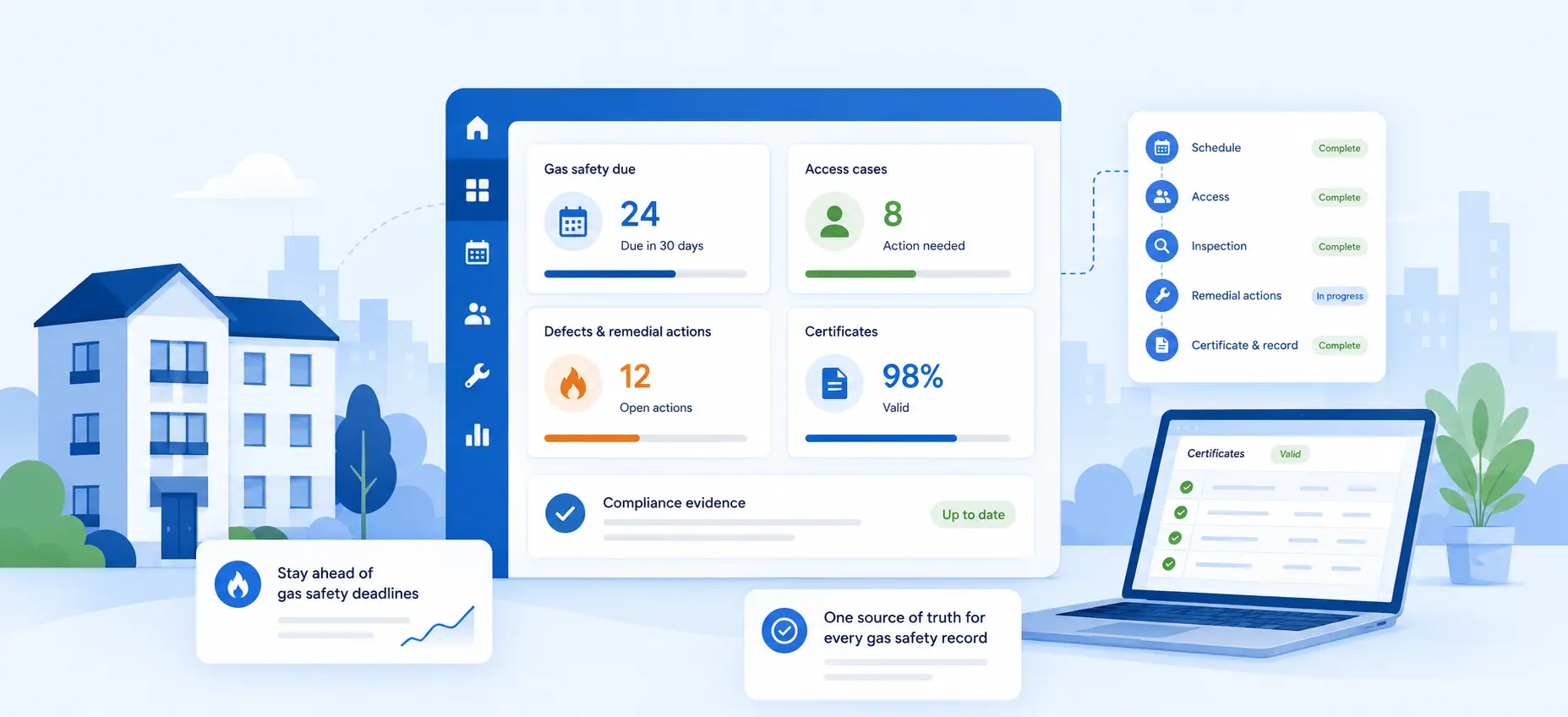
Your live assurance view should show:
- properties with checks approaching their internal or statutory deadlines
- overdue checks and unresolved access cases
- certificates awaiting validation or rejected for correction
- defects and remedial actions by priority and age
- properties with capped supplies or disconnected appliances
- resident records awaiting issue
- differences between contractor, asset and compliance data
Every exception should have an owner, a deadline and a defined escalation route. Without those three elements, a dashboard is only a more colourful spreadsheet.
A practical assurance test
Choose a small sample of properties and try to reconstruct the full compliance history without asking the contractor or the person who manages the spreadsheet.
For each property, can you show:
- why it is in scope
- how the current due date was calculated
- who completed the check and whether they were registered
- the complete and validated gas safety record
- evidence that the resident received a copy
- every defect and the evidence of closure
- all access activity where the check was delayed
If the evidence only makes sense after someone explains it, the process is still relying on individual knowledge rather than organisational control.
Manual gas safety gaps are rarely caused by one dramatic failure. They develop through small disconnections between properties, dates, visits, records and actions. Fixing them means creating one controlled evidence trail that follows each home from scheduling through to verified closure.
If you are reviewing how this information is managed across your portfolio, the True Compliance gas safety streamconnects due dates, certificate validation, access cases and remedial actions in one process.