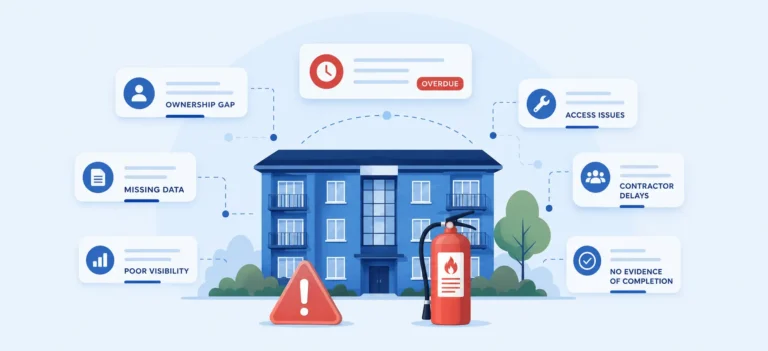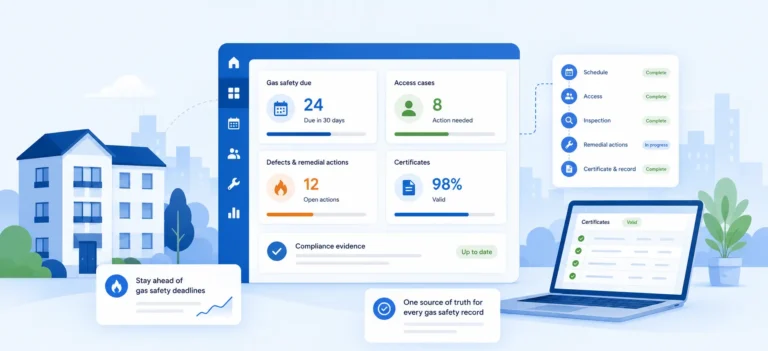

Missed fire safety actions rarely begin with nobody identifying the risk. More often, an assessor records a defect, a manager sends it to a contractor, somebody updates a spreadsheet, and the action quietly disappears between systems, teams or contract boundaries.
The awkward part is rarely the inspection itself. It is maintaining control from the moment an action is raised until the work has been completed, evidenced and verified.
That distinction is particularly important in 2026. In England, the Regulatory Reform (Fire Safety) Order 2005 requires Responsible Persons to assess fire risks and establish appropriate arrangements for planning, organisation, control, monitoring and review. Changes introduced through section 156 of the Building Safety Act 2022 also require Responsible Persons to record their fire risk assessments in full and document how fire safety is managed.
This article focuses on social housing in England. The Fire Safety Order also extends to Wales, but the additional regulations discussed below apply in England only. Scotland and Northern Ireland operate under separate fire safety regimes.
Key takeaways
- A completed fire risk assessment is not proof that the actions it generated have been resolved.
- Every action needs a named owner, due date, risk priority, escalation route and closure standard.
- Contractor attendance, job completion and verified risk resolution are three different stages.
- Recurring checks must be controlled alongside one-off remedial actions and changes to the building.
- From 6 April 2026, action management for buildings in scope must also cover Residential Personal Emergency Evacuation Plans.
- Your evidence should allow somebody outside the operational team to understand what was found, what was done and why the action was closed.
Why fire safety actions get missed
A single building can generate actions from several different sources:
- fire risk assessments
- fire door inspections
- alarm, smoke-control and sprinkler servicing
- lift and firefighting equipment checks
- compartmentation surveys
- resident reports
- construction and refurbishment work
- fire and rescue service inspections
- person-centred fire risk assessments
Problems develop when these actions are stored in different systems or managed by different teams. An assessment may sit in a document-management system, the repair may be raised in a works-order platform, and the contractor’s evidence may arrive by email.
Each part of the process can appear complete while the overall risk remains open.
Create one live fire safety action register.
Housing providers need one controlled view of every open fire safety action. This does not necessarily mean replacing every operational system, but it does mean establishing a single live record that reconciles information from assessments, repairs, servicing and contractor systems.
Each action should include:
- the building, location and asset affected
- the report, inspection or event that raised it
- a clear description of the defect and required outcome
- the risk rating and priority
- the named owner
- the target completion date
- any interim control measures
- access, procurement or technical dependencies
- the current status
- the evidence required for closure
- the person responsible for verifying completion
- the next review date, where applicable
Avoid copying vague wording such as “repair fire door” into the register. State what is defective, which door is affected and what condition must be restored.
The practical test is whether someone unfamiliar with the original assessment could understand and manage the action from the register alone.
Separate attendance, completion and verified closure
A contractor marking a job as complete does not automatically mean the fire safety action can be closed.
Use a defined workflow, for example:
- Raised: The finding has been recorded against the correct building and asset.
- Triaged: The risk, target date and any interim measures have been agreed.
- Assigned: A named employee retains ownership, even where a contractor delivers the work.
- Work completed: The contractor confirms what was done.
- Evidence received: Photographs, certificates, test results or updated plans have been supplied.
- Verified: A competent reviewer confirms that the original risk has been addressed.
- Closed: The action record contains a complete and traceable evidence trail.
This prevents “operative attended” or “job financially completed” from being mistaken for a resolved fire safety risk.
Keep ownership inside the organisation.
Contractors can inspect, service and repair assets, but outsourcing the work does not remove the Responsible Person’s duties. Government guidance on the Fire Safety (England) Regulations 2022 confirms that Responsible Persons may engage contractors to assist, while retaining responsibility for compliance.
Every action should therefore have an internal owner who can:
- challenge unclear recommendations
- secure funding or approval
- manage access and dependencies
- monitor the contractor
- approve extensions or interim controls
- escalate missed dates
- verify the final evidence
Where a building has several Responsible Persons or an Accountable Person under the building safety regime, responsibilities should be explicitly mapped. Section 156 requires Responsible Persons to take reasonably practicable steps to identify others with duties for the same premises and cooperate with them.
“Someone else’s responsibility” is not a useful status.
Control recurring requirements alongside remedial actions
A robust process must manage routine obligations as well as defects from a fire risk assessment.
Under the Fire Safety (England) Regulations 2022, Responsible Persons must undertake specific activities according to building height and type. These include:
- minimum monthly checks of firefighters’ lifts and essential firefighting equipment in high-rise residential buildings
- notification to the fire and rescue service where specified equipment is out of order for more than 24 hours
- quarterly checks of communal fire doors in multi-occupied residential buildings over 11 metres
- best-endeavours annual checks of flat entrance doors in those buildings
- provision of fire safety instructions and fire-door information to residents in all multi-occupied residential buildings
High-rise residential buildings are defined for these regulations as buildings at least 18 metres high or with seven or more storeys.
These requirements should generate scheduled tasks before they become due. The system should also identify missed inspections, unsuccessful access attempts and overdue follow-up work rather than treating the inspection schedule as complete once appointments have been created.
Add Residential PEEPs to the action process.
The Fire Safety (Residential Evacuation Plans) (England) Regulations 2025 came into force on 6 April 2026. They apply to high-rise residential buildings and to multi-occupied residential buildings over 11 metres that use a simultaneous evacuation strategy.
For buildings in scope, Responsible Persons must use reasonable endeavours to identify residents who may have difficulty evacuating without assistance. Where an identified resident requests one, the Responsible Person must arrange a person-centred fire risk assessment, discuss reasonable and proportionate mitigating measures and seek to agree a written emergency evacuation statement.
The process must be reviewed at least every 12 months, when circumstances indicate that it needs updating or following a reasonable request from the resident. Prescribed information may also need to be provided to the fire and rescue authority, subject to the resident’s explicit agreement.
These are live actions rather than documents to produce once. Your register may need to track:
- offers and requests for assessments
- assessment appointments
- agreed mitigation measures
- equipment installation or building work
- written evacuation statements
- resident consent for information sharing
- annual and event-triggered reviews
- changes in a resident’s needs or circumstances
Access to this information must be appropriately controlled because it may contain sensitive personal data.
Make failed access visible.
Access problems are common in residential fire safety work, particularly for flat entrance door checks and resident-specific assessments. A failed appointment should not remove the property from the programme or leave the action indefinitely marked as “in progress”.
Record:
- each access attempt
- how and when the resident was contacted
- any known barriers or support needs
- the next attempt date
- the risk decision
- the agreed escalation route
- any interim measures
For annual flat entrance door checks, the regulations require best endeavours. The evidence should therefore demonstrate a reasonable, organised and persistent process, not simply record “no access”.
Define what evidence closes each action.
Set the closure requirement when the action is created, not when someone asks to close it.
Depending on the action, suitable evidence may include:
- dated before-and-after photographs
- commissioning or test certificates
- fire-door inspection records
- product and installation information
- updated floor or building plans
- confirmation that information was sent to the fire and rescue service
- proof that resident instructions were issued
- a competent person’s verification
- an updated fire risk assessment or review record
The Fire Safety Act 2021 confirms that, in multi-occupied residential buildings, the Fire Safety Order covers the building’s structure and external walls, including balconies, as well as flat entrance doors opening onto common parts. Evidence and action records should reflect that scope.
Use exception reporting, not reassuring averages.
Portfolio-level reporting should direct attention towards what is not under control. Useful measures include:
- overdue actions by risk rating
- high-risk actions without interim controls
- actions awaiting contractor evidence
- failed access cases without a future appointment
- actions reopened after verification
- recurring checks missed or completed late
- average time from work completion to verified closure
- PEEP mitigation measures awaiting implementation
- buildings with unreconciled actions across different systems
A report stating that 95% of actions are complete may sound positive. It says very little if the remaining 5% contains the oldest or highest-risk defects.
A practical assurance test
For each open or recently closed action, you should be able to answer:
- What risk was identified?
- Who owns the action?
- When is it due?
- What is protecting residents in the meantime?
- What work has been completed?
- What evidence has been received?
- Who verified that the original risk was resolved?
Preventing missed fire safety actions does not depend on a more elaborate spreadsheet or another round of assurance meetings. It depends on a boring, repeatable process that connects every finding to an owner, deadline, escalation route and verified outcome.
The assessment is only the start. The real measure of control is whether you can prove that every action reached a defensible close.