A missed fire compliance task is rarely caused by someone simply forgetting a date. More often, the task passes through several teams, systems and contractors before a gap appears between what was required, what was completed and what the organisation can prove.
The inspection itself is only one part of the process. Housing providers must also identify the correct assets, appoint competent people, manage access, receive usable records, resolve defects and verify that every action has been closed.
The awkward part is rarely putting a date in a calendar. It is keeping the entire chain under control across a housing portfolio.
This article focuses primarily on social housing in England. The principal fire safety regimes differ elsewhere in the UK, including the Fire (Scotland) Act 2005 and the Fire and Rescue Services (Northern Ireland) Order 2006.
Key takeaways
- Missed tasks usually develop through several small control failures rather than one isolated mistake.
- An unclear asset register can prevent a task from being created, even when the inspection programme itself is well managed.
- Giving work to a contractor does not transfer the Responsible Person’s legal duties.
- Attendance, inspection and compliance are different stages. A visit is not complete if defects, reports or evidence remain outstanding.
- Fire compliance systems should highlight exceptions early enough for teams to intervene before a deadline passes.
- A defensible process connects every requirement to an asset, owner, due date, outcome, remedial action and supporting record.
What counts as a missed fire compliance task?
The obvious example is an inspection that has not taken place by its due date. However, a task can also be operationally incomplete when:
- an inspection happened, but no report was received
- a fire risk assessment identified actions that remain open
- a defect was marked complete without evidence
- an unsuccessful access attempt was not escalated
- a change to the building did not trigger a review
- records cannot be matched to the correct property or asset
- required information was not issued to residents or the fire and rescue service
This distinction matters because compliance is not simply the activity. It is the activity, the response to its findings and the evidence showing that the process reached a controlled conclusion.
The legal and regulatory baseline
Under the Regulatory Reform (Fire Safety) Order 2005, which applies in England and Wales, the Responsible Person must assess fire risks, establish appropriate fire safety arrangements and maintain relevant precautions, equipment and systems. Fire risk assessments and fire safety arrangements must also be recorded.
The Fire Safety Act 2021 clarified that, in buildings containing two or more domestic premises, the Fire Safety Order can apply to the building’s structure, external walls, common parts and doors between flats and common parts.
In England, the Fire Safety (England) Regulations 2022 add recurring requirements for multi-occupied residential buildings. Depending on building height, these include resident information, fire door checks and routine checks of lifts and essential firefighting equipment. The requirements have applied since 23 January 2023.
Registered providers in England must also meet the Regulator of Social Housing’s Safety and Quality Standard. This requires providers to identify and meet applicable health and safety requirements and to complete actions arising from legally required assessments within appropriate timescales.
This is general information, not legal advice.
Why fire compliance tasks are missed
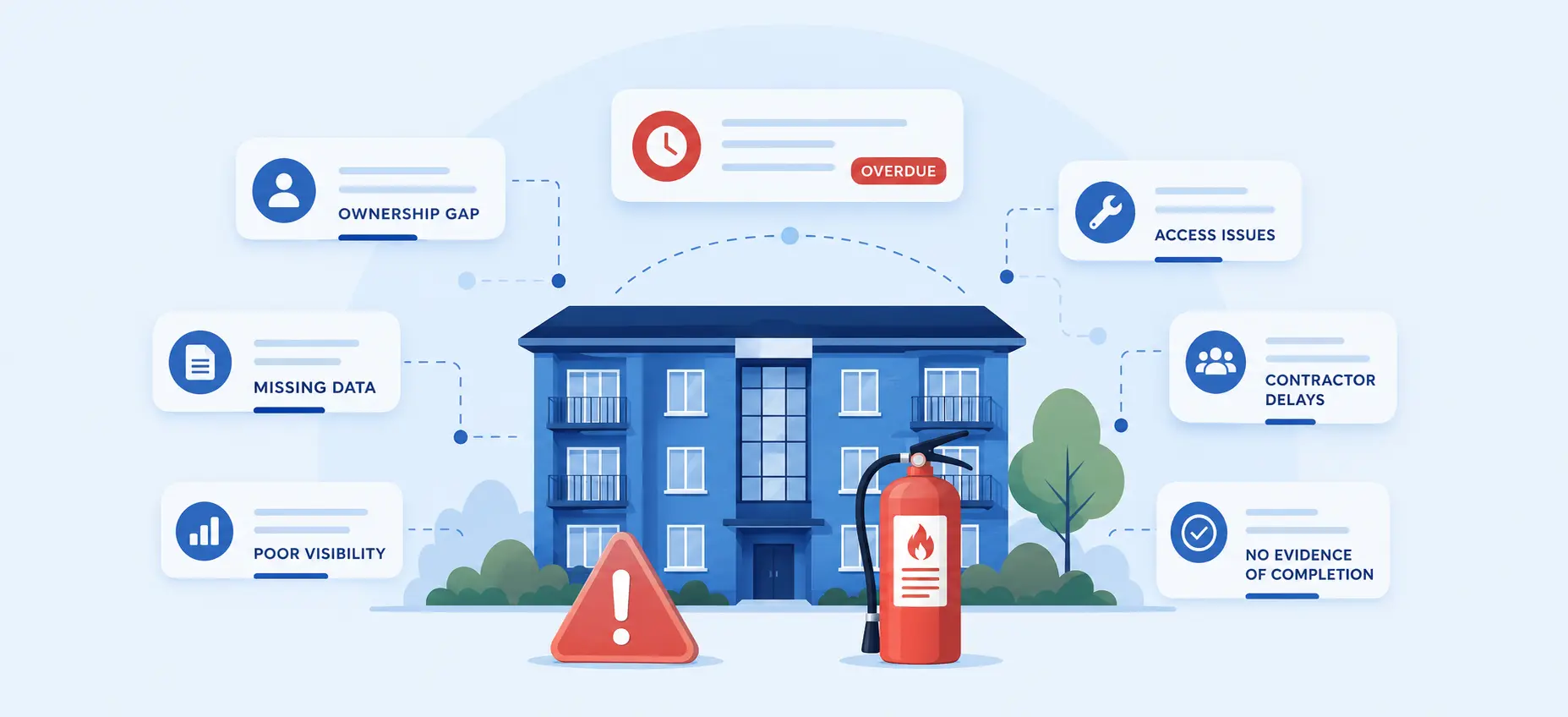
Ownership is unclear
Tasks are vulnerable when responsibility is described at team level rather than assigned to a named role or individual.
The compliance team may maintain the programme, an operational team may arrange access, a contractor may carry out the inspection and an asset team may fund remedial work. Unless responsibility is clear at each stage, everyone can complete their part while the overall task remains unresolved.
Appointing a contractor does not remove the Responsible Person’s duties. Government guidance confirms that responsibility cannot simply be delegated, even though other parties will usually be appointed to assist with delivery.
A workable process records who owns:
- scheduling
- access
- technical review
- remedial work
- evidence validation
- final close-out
The asset register is incomplete.
You cannot schedule a task for an asset the organisation does not know exists.
Property acquisitions, disposals, conversions, changes in building height data and unidentified communal equipment can all affect the scope of a fire compliance programme. Problems also arise when the property hierarchy does not show which blocks, cores, communal areas or systems belong together.
The result is often a technically accurate inspection programme built on an inaccurate list of assets.
Dates are spread across several systems.
Fire risk assessments, fire door checks, alarm servicing, emergency lighting tests and remedial actions may be managed in different applications or contractor portals.
When each system holds part of the compliance position, teams must reconcile dates manually. Reports can arrive by email, appointments may sit in a contractor platform, and remedial jobs may be raised in a repairs system without a reliable link back to the original finding.
This creates several versions of “complete”, none of which necessarily represents the whole process.
Access failures do not trigger early action.
Access can affect flat entrance door checks, in-flat equipment connected to communal systems and work that requires entry through residents’ homes.
A missed appointment should begin an escalation process, not merely produce another appointment date. Without clear triggers, repeated access attempts can continue until the compliance deadline is too close for recovery.
The process should define the number and timing of attempts, communication methods, support for residents with additional needs and the point at which management or legal intervention is considered.
Contractors are measured by visits rather than outcomes.
A contractor may report strong appointment completion while the housing provider still has missing reports, rejected records and unresolved defects.
Useful contractor controls should cover:
- attendance within the required window
- report submission times
- data accuracy and mandatory fields
- defect classification
- photographic or technical evidence
- failed-access notifications
- remedial quotations and completion evidence
The practical question is not only whether the contractor attended. It is whether the provider received enough accurate information to make the next decision.
Remedial actions become detached from the inspection.
An inspection can be completed on time while the risks it identified remain open.
This frequently happens when defects are transferred into a separate repairs or capital works process. The original compliance record may then show a finished assessment, while the resulting actions have different owners, priorities and reference numbers.
Every action should retain a traceable connection to its source, including the affected asset, risk level, target date, interim controls, responsible owner and verified closure evidence.
Building changes do not trigger a review.
Compliance dates should not operate in isolation from changes to the building.
Alterations, refurbishment, changes in use, damage, new equipment and updated resident needs may affect the fire risk assessment or the measures already in place. High-rise building plans supplied to the fire and rescue service must also be updated when the layout or location of key firefighting equipment changes.
A change-control process should therefore ask whether proposed or completed work affects the current assessment, evacuation arrangements, compartmentation, fire doors or firefighting systems.
Records are accepted without validation.
A PDF in a folder is not automatically reliable evidence.
Reports can contain the wrong address, incomplete asset references, missing signatures, unclear recommendations or dates that do not match the visit. These issues become harder to correct when they are discovered months later during an audit.
Evidence should be checked when it enters the system, while the contractor and operational context are still available.
How to reduce missed tasks
A controlled fire compliance process should provide one live view of:
- Every property, building and asset in scope.
- The requirement and frequency that apply.
- The previous and next due dates.
- The person responsible for delivery.
- Appointment, access and escalation status.
- Inspection findings and outstanding actions.
- Interim measures where work cannot be completed immediately.
- Approved evidence and verified closure.
Exception reporting should then focus attention on approaching deadlines, failed appointments, overdue reports, rejected evidence and remedial actions that are drifting beyond target dates.
The most useful assurance question is not, “How many tasks did we complete?” It is, “Which required tasks are not yet under control, and what evidence supports that assessment?”
That is the difference between a busy fire safety programme and one that will stand up to scrutiny.