
For social housing providers, the practical question is really this: what inspection frequency will withstand scrutiny from an insurer, a regulator, and your own audit trail, across thousands of homes and shared spaces? The answer starts with policy wording and insurer survey actions, then anchors to the fixed cycles set in law and guidance.
Key takeaways
- There’s no single inspection interval called “insurance compliance”. You’re managing several regimes at once, plus insurer requirements.
- Some checks have fixed maximum gaps, like annual gas safety checks.
- Others have set intervals (or a scheme alternative), like LOLER with thorough examinations at 6 or 12 months, depending on the equipment.
- Some building safety duties are now specified by frequency, including fire door checks and monthly inspections of firefighting lifts in certain buildings.
- Where the law doesn’t prescribe an exact interval, you still need a defensible routine and a clear evidence pack, especially at renewal when insurers expect risk information to be “clear and accessible”.
Why “insurance compliance” doesn’t have one timetable
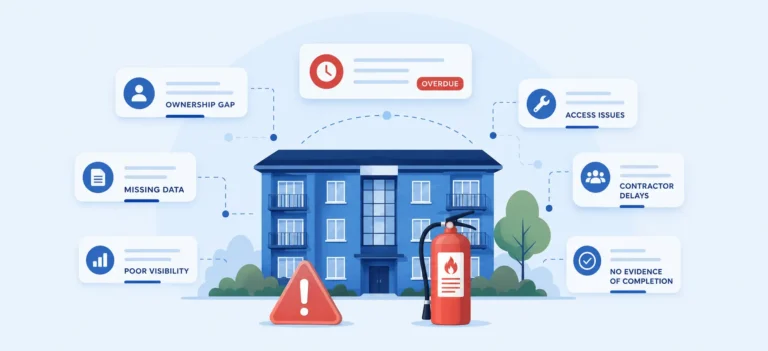
Insurance compliance is contractual and evidence-led. Your insurer wants proof that risks are being managed, inspections are current, defects are closed out, and nothing important is being buried in someone’s inbox.
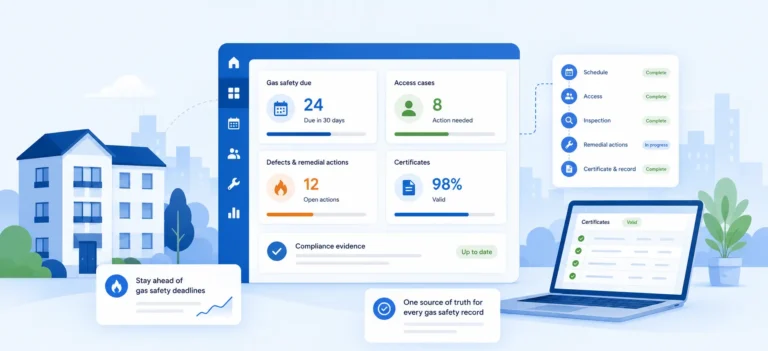
That matters at renewal. Under the Insurance Act 2015, a fair presentation of risk has to be made in a way that’s “reasonably clear and accessible” to a prudent insurer. In practice, that pushes providers towards a single inspection timeline and a tidy evidence trail, rather than scattered PDFs and competing spreadsheets.
So instead of chasing a made-up “annual insurance inspection”, you build a schedule around the inspection types that insurers routinely ask about.
The inspection frequencies that are fixed or clearly stated
These are the ones that can’t be hand-waved away with “we’ll get to it next quarter”.
Gas safety (in-home)
Landlords must ensure gas appliances and flues are checked for safety within 12 months of installation and at intervals of no more than 12 months since the last check, with records kept.
For providers, this is a volume game: access, appointments, no-access processes, and clean record keeping.
Electrical installations (England, social rented homes)
Government guidance says electrical installations must be inspected and tested by a qualified person at least every 5 years, with a report produced.
For social rented homes in England, the extension dates are outlined as follows: duties apply for new tenancies from 1 December 2025, and for existing tenancies from 1 May 2026, with a deadline to complete the required inspections and equipment checks by 1 November 2026.
Lifts and lifting equipment (LOLER)
The default thorough examination intervals are (unless you use a competent-person examination scheme):
- Every 6 months for lifting equipment and accessories used to lift people
- Every 6 months for lifting accessories
- Every 12 months for other lifting equipment
In a housing context, this often covers passenger lifts and some platform lifts in communal areas.
Fire doors and firefighting lift checks (England)
The Fire Safety (England) Regulations 2022 brought in specific routine checks for certain multi-occupied residential buildings:
- For high-rise residential buildings, a minimum of monthly checks on lifts for firefighters and essential firefighting equipment
- For buildings over 11 metres, quarterly checks on communal fire doors and annual checks on flat entrance doors
This sits alongside the wider requirement to carry out and regularly review a fire risk assessment.
The inspections where the interval is set by a “scheme”, not a calendar
Some risks don’t come with a neat “every X months” rule. They come with a requirement to have a competent person define what “safe” looks like and how often it must be checked.
Pressure systems (plant rooms, boilers, air receivers, etc.)
Before using qualifying pressure equipment, a written scheme of examination must be in place, and an examination carried out.
The regulations then require examination within the intervals specified in that scheme.
For providers, the practical step is making sure every relevant asset is in scope, every scheme is current, and the inspection dates are being tracked in a way you can evidence.
The “change-trigger” inspections people forget
Even where you have a routine cycle, inspections also need to happen when something changes.
HSE’s lifting equipment guidance flags triggers like after assembly, and following exceptional circumstances such as damage, long periods out of use, or major modification.
Fire risk assessments also need to be regularly reviewed, not filed and forgotten.
Insurers tend to care a lot about these moments, because claims often happen right after change: refurbishment, contractor churn, new plant, new residents, new use of a building.
A workable inspection schedule for social housing teams
A schedule that holds up to scrutiny usually has four layers:
- Your policy and insurer requirements
Pull out warranties, conditions, survey actions, and any “risk improvement” deadlines. This is the bit that’s unique to your cover. - Fixed-cycle statutory checks
Gas annually, electrical five-yearly (England, now explicit for social rented homes), LOLER six or twelve months, and the fire door and firefighting lift check frequencies where the regulations apply. - Scheme-based regimes
Pressure systems and anything else that depends on a competent person’s scheme. - Assurance checks
Short, internal checks that stop you from finding out you’ve slipped when the insurer asks. For example, monthly reviews of what’s coming due, what’s overdue, and what actions are still open.
Run inspections on the cycle the law or scheme requires, then add the insurer layer on top. The “right” frequency is the one you can prove, building by building, asset by asset, with a paper trail that makes sense outside your team.
If you’re looking to make insurance inspection compliance easier, you could consider using software. True Compliance’s Insurance Compliance page might be a good place to start.