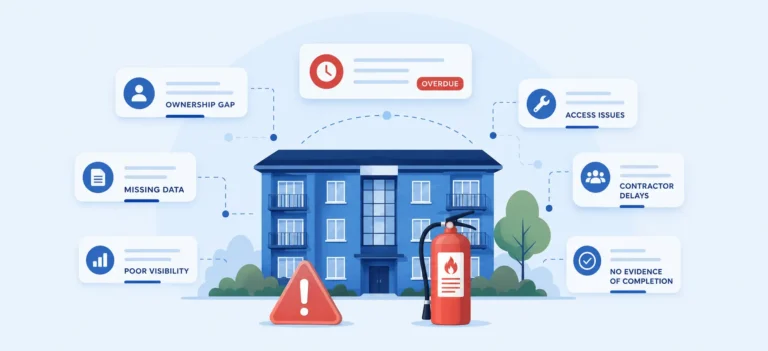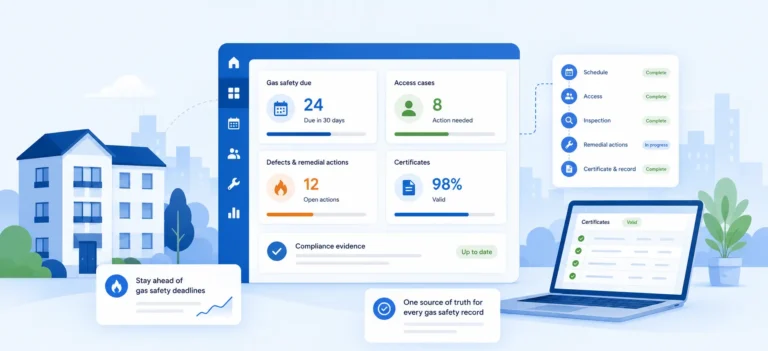
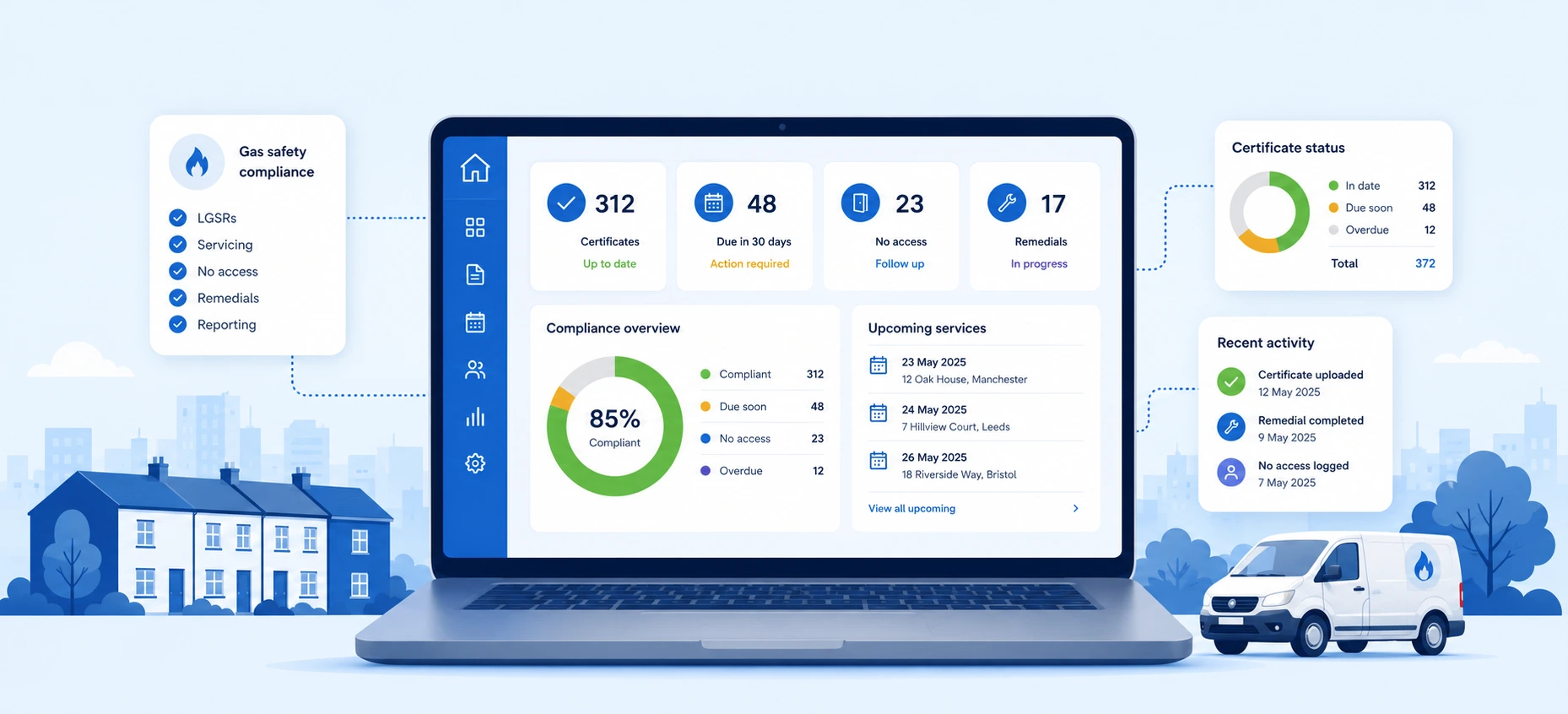
Gas safety compliance software should do more than remind you when a Landlord Gas Safety Record (LGSR) is due. Across a housing portfolio, the difficult work involves checking records, controlling no-access cases, tracking defects, coordinating contractors and proving that every necessary action reached a proper conclusion.
The awkward part is rarely the annual inspection itself. It is keeping properties, appliances, appointments, documents and follow-up work connected when several teams and suppliers are involved.
This guide compares six platforms that support gas safety compliance in UK housing. The selection is based on publicly available product information reviewed in July 2026, with particular attention paid to social housing suitability, gas-specific workflows, document control, remedial tracking, integrations and reporting.
Key takeaways
- True Compliance provides a dedicated social housing gas safety workflow covering certificates, no-access cases, capped meters and remedial actions.
- Propeller combines compliance oversight with gas certification, scheduling, contractor management and mobile working.
- Plentific connects gas safety monitoring with inspections, repairs, renewals and contractor mobilisation.
- MRI Asset Management places recurring gas servicing within a wider asset and planned-maintenance system.
- Civica Cx is most relevant where gas servicing needs to connect with existing repairs and workforce processes.
- Aareon HomeMaster supports gas servicing as part of an integrated housing, asset and resident-management environment.
What gas safety software needs to control
In Great Britain, regulation 36 of the Gas Safety (Installation and Use) Regulations 1998 requires landlords to arrange gas safety checks at intervals of no more than 12 months for relevant appliances and flues. The work must be completed by a suitably qualified Gas Safe registered engineer.
Northern Ireland has a separate legal regime under the Gas Safety (Installation and Use) Regulations (Northern Ireland) 2004, including landlord duties under regulation 36. Housing providers operating across the UK should therefore confirm that their system can accommodate the correct jurisdiction rather than applying one policy indiscriminately.
In Great Britain, landlords must retain the gas safety record for at least two years, provide it to existing residents within 28 days of the check and give new residents a current record before they move in. The Health and Safety Executive also confirms that checks can be completed during the two months before the deadline while preserving the existing renewal date, provided the relevant requirements are followed.
A useful platform should therefore control:
- properties, appliances and servicing dates
- LGSR receipt, checking and storage
- Gas Safe engineer information
- access attempts and escalation
- defects, warning notices and capped supplies
- remedial work, ownership and closure evidence
- resident record distribution
- contractor performance and recurring failures
- portfolio, management and board reporting
This is general information, not legal advice.
1. True Compliance: best for a dedicated gas safety workflow
True Compliance Gas Safety is designed specifically around building compliance in social housing rather than general property administration.
Its gas safety capability centralises certificates, tracks compliance dates and automates no-access workflows. The platform also supports remedial actions, capped-meter cases and evidence management, allowing teams to follow an issue from the initial record through to verified closure.
This makes it particularly relevant where the main challenge is not booking the inspection, but controlling what happens after the LGSR arrives. Contractors and landlord teams can work from the same compliance information, while overdue checks and unresolved actions remain visible.
Best suited to: Housing associations and local authorities seeking a dedicated gas compliance system with strong certificate, access and remedial workflows.
2. Propeller: best for workforce and contractor management
Propeller’s Compliance Management Solution supports gas, electrical, fire, legionella, asbestos and lifting-equipment compliance for social housing landlords.
Its gas-focused tools include job management, digital certification, scheduling, mobile applications and asset information. Role-based dashboards can also report on areas such as access rates, engineer performance, first-time fixes and overall compliance.
This combination is useful where the landlord, a direct labour organisation and external contractors all need to exchange operational information. The platform covers both the compliance position and the workforce activity required to maintain it.
Best suited to: Housing providers and contractors looking to combine gas compliance reporting with scheduling, certification and mobile workforce management.
3. Plentific: best for connecting compliance with repairs
Plentific’s Compliance Management Solution covers gas, electrical, fire, lift and water safety within a wider property-operations platform.
The system brings together inspections, renewal dates, repairs and supporting evidence through real-time dashboards. Users can record urgent breaches, prioritise work according to risk and mobilise contractors through the platform.
Plentific is particularly relevant where compliance information and repair delivery currently sit in separate systems. Its model is intended to connect the identification of a problem with the work required to resolve it, although housing providers should test the precise depth of LGSR checking and no-access escalation during procurement.
Best suited to: Providers wanting gas safety monitoring integrated with repairs, maintenance and contractor procurement.
4. MRI Asset Management: best for wider asset planning
MRI Asset Management places recurring servicing within a broader social housing asset-management environment.
Its servicing capability can be used to manage recurring inspections and maintenance across several compliance streams, including gas safety. The wider platform brings together asset hierarchies, component information, planned programmes, tasks and management dashboards.
This approach is likely to be most valuable where gas servicing dates need to sit alongside boiler information, component replacement plans, stock-condition data and longer-term investment decisions. Providers should confirm how certificates, defects and remedial evidence are handled in their proposed configuration.
Best suited to: Medium and large housing providers wanting gas servicing connected to strategic asset data and planned maintenance.
5. Civica Cx Contractor Workforce: best for existing Civica environments
Civica Cx Contractor Workforce supports responsive, planned, void and cyclical work, including gas and electrical servicing requirements.
Because it operates within the Civica Cx Housing environment, servicing activity can be connected with wider property, repairs and resident information. Mobile functionality allows operatives to receive work and record job details in the field, while managers can monitor workload, progression and costs.
Its main strength is operational integration rather than specialist LGSR interrogation. Providers should ask Civica to demonstrate certificate checking, defect escalation, no-access management and closure evidence using realistic gas safety cases.
Best suited to: Housing providers already using Civica Cx that want gas servicing embedded within repairs and contractor operations.
6. Aareon HomeMaster: best for integrated housing management
Aareon HomeMaster is a cloud-based housing management platform that connects property, tenancy, asset and operational information.
Aareon’s published case study for Barrhead Housing Association describes automated gas-servicing and asset-management workflows, supported by dashboards and quick-access information. The wider system is intended to provide one source of information across housing, finance and resident-management processes.
This may suit providers seeking to reduce the number of separate applications used across the organisation. The trade-off is that buyers need to examine whether the configured gas process provides the same level of certificate scrutiny and remedial control as a specialist compliance platform.
Best suited to: Housing providers seeking to manage gas servicing within a wider housing management system.
How to choose the right platform
Start with the point at which your present process tends to fail. A polished dashboard will not help if certificates arrive against the wrong property, while automated document handling will not solve a poorly controlled no-access procedure.
During demonstrations, ask each supplier to show how the system handles one difficult case from beginning to end:
- An LGSR arrives from a contractor.
- The record contains a defect or missing information.
- The system flags or rejects the record.
- A remedial action is assigned to a named owner.
- Access cannot be obtained on the first attempt.
- The case is escalated under the landlord’s policy.
- The work is completed and independently verified where necessary.
- The final evidence is linked to the property, appliance and original record.
- Management can retrieve the full history without reconstructing it from emails.
You should also test data migration, integrations, role-based permissions, audit logs, resident communications, contractor onboarding, reporting flexibility and exit arrangements.
The practical question is whether the system can show what is compliant, what is not, who owns the next action and whether the evidence would make sense to somebody outside the gas team.
A gas certificate is only one part of the evidence.
The best gas safety compliance software is the platform that fits your delivery model and closes the gaps between inspection, certificate, defect and remedial work.
For providers seeking a dedicated social housing compliance platform, True Compliance connects gas safety records, access cases, assets and follow-up actions within one live evidence trail.
Whatever system you select, test it against missed appointments, rejected records and unresolved defects rather than a tidy demonstration property. That is usually where the real difference becomes visible.