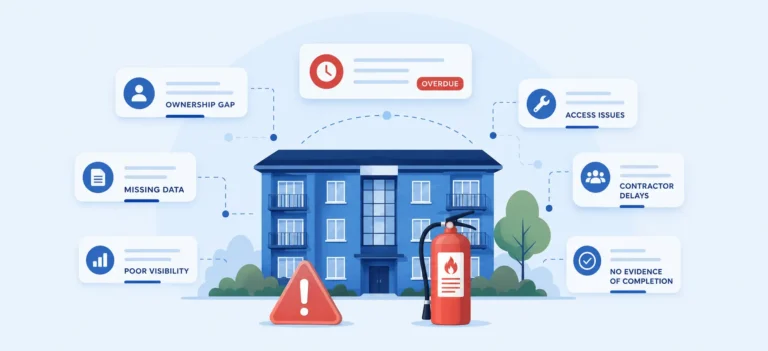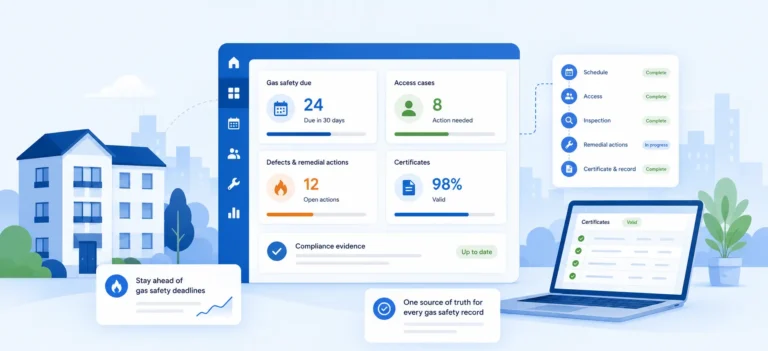

An asbestos survey report records what a surveyor found at a particular point in time. It does not, by itself, show whether materials have since deteriorated, whether remedial actions were completed or whether contractors received the right information before starting work.
That distinction matters because the law does not ask housing providers to collect an annual “asbestos certificate”. Under the Control of Asbestos Regulations 2012, dutyholders must maintain an up-to-date record of asbestos-containing materials, assess the risk, prepare a management plan and keep those arrangements under review.
Replacing static certificates therefore means more than scanning old reports into a new system. The practical objective is a live asbestos record connected to inspections, actions, works and the people who need the information.
Key takeaways
- “Asbestos certificate” is not the main legal record required by Regulation 4. Housing providers normally need a current asbestos register and a site-specific management plan.
- A PDF can remain part of the evidence trail, but it should not be the only place where current asbestos information is held.
- Each asbestos-containing material should be recorded as a manageable item with its location, condition, risk, actions and inspection dates.
- Contractors must receive relevant asbestos information before they start work that could disturb the building fabric.
- The register should change when materials deteriorate, work is completed, new areas are surveyed, or asbestos is repaired or removed.
- A successful migration is measured by current, accessible and traceable information, not by the number of documents uploaded.
What is a static asbestos certificate?
Housing teams often use “certificate” as a general label for several different documents, including:
- management survey reports
- refurbishment or demolition survey reports
- reinspection reports
- laboratory results
- removal documentation
- air monitoring and clearance certificates
These documents remain important evidence, and original reports should be retained. The problem arises when a dated document becomes the operational source of truth long after the building, material, or risk has changed.
A contractor opening a two-year-old PDF may not see that an asbestos-containing panel was damaged last month. A compliance manager reviewing a survey folder may not know that a removal action is overdue. A repairs operative may not receive information about an inaccessible area where asbestos must still be presumed.
The document is not necessarily wrong. It is simply static.
What the law expects housing providers to maintain
For England, Wales and Scotland, Regulation 4 of the Control of Asbestos Regulations 2012 applies to non-domestic premises and the common parts of multi-occupied domestic buildings. Northern Ireland has a separate, closely aligned regime under the Control of Asbestos Regulations (Northern Ireland) 2012.
The Health and Safety Executive (HSE) describes the asbestos register as a live document that must contain current information about known and presumed asbestos-containing materials. It should be updated at least annually and sooner where the risk or condition changes.
The associated asbestos management plan should identify responsibilities, monitoring arrangements, information-sharing controls, emergency procedures and the measures used to prevent disturbance. HSE confirms that the plan may be written or electronic, provided it is easy to find, understand and update.
There is no prescribed software platform or mandatory digital certificate. A paper-based system can comply if it is complete, current and accessible. Across a large housing portfolio, however, keeping hundreds or thousands of disconnected documents current is an awkward way to prove control.
What should replace static certificates?
The replacement should be a live asbestos register supported by the original evidence, rather than a new document with a different file extension.
For each known or presumed asbestos-containing material, the record should normally include:
- a unique asset or material reference
- the building, block, floor, room and exact location
- whether asbestos was sampled, strongly presumed or presumed because access was unavailable
- the material and product type
- its extent and current condition
- photographs or marked plans where useful
- the material and priority assessments
- the date of the original and most recent inspection
- the next condition-check date
- the required management action
- the action owner and target date
- evidence that repairs, encapsulation or removal were completed
- links to the supporting survey and analytical documents
- a history of changes to the record
This structure turns the survey finding into something that can be monitored and acted upon. It also allows the housing provider to distinguish “survey complete” from “risk under control”.
How to replace the certificates step by step
1. Decide which record is authoritative
Start by defining one controlled source for current asbestos information. Survey PDFs, spreadsheets, contractor portals and document-management folders may continue to hold supporting evidence, but they should not present competing versions of the current position.
Set clear rules for who can create, verify and amend asbestos records. The responsible person should also know who acts as deputy when they are unavailable.
2. Build a complete document inventory
Identify every source that may contain asbestos information, including legacy surveys, reinspection reports, removal records, photographs, plans and contractor-held data.
Map each document to the correct property, block and area. Duplicate addresses, changed asset references and inconsistent room descriptions should be resolved before migration, not carried silently into the new register.
3. Extract findings at material level
Uploading an entire survey against a property is not enough. Each asbestos-containing material, presumed material and inaccessible area should become an individual record that can be inspected, updated and linked to an action.
Retain the original survey as evidence, but make its operational findings searchable without requiring someone to read a 70-page report before every repair.
4. Validate the migrated information
A competent person should check that:
- all relevant buildings and common parts are represented
- survey limitations and exclusions are visible
- inaccessible areas have not been mistaken for asbestos-free areas
- removals and repairs are reflected correctly
- inspection dates and actions agree with the source documents
- duplicate or contradictory findings have been resolved
Where the evidence is unclear, record the uncertainty and arrange further investigation. A neat-looking register built from unreliable data is still unreliable.
5. Connect asbestos information to work orders
The asbestos record should be checked before repairs, maintenance, refurbishment or installation work that could disturb the building fabric.
HSE states that employees and contractors must receive information about the location and condition of asbestos before relevant work begins. This should include site liaison arrangements and the controls required for safe working.
In practice, this means integrating the asbestos check into the work-order process rather than relying on operatives to find a separate folder. Where the available information does not cover the work area or the required level of intrusion, the job should stop until the appropriate survey or assessment has been completed.
6. Create event-driven updates
Do not wait for the annual review to correct a record that is already known to be wrong.
The register should be updated when:
- an asbestos-containing material deteriorates
- a condition inspection is completed
- an area is surveyed for the first time
- sampling changes a presumed finding
- material is repaired, enclosed or removed
- refurbishment changes the likelihood of disturbance
- an incident or accidental disturbance occurs
- responsibility for an action changes
The annual review remains an important assurance control, but it is not a substitute for updating information when the underlying facts change.
7. Preserve the audit trail
Every material change should record who made it, when it was made, and what evidence supported the decision.
This is particularly important where a material is marked as removed, or an action is closed. The system should retain the previous status and link the closure to the relevant contractor record, analyst’s certificate, photograph or completion evidence.
The practical test is simple: could someone independent follow the record from the original finding through to the current condition and management decision?
Common replacement mistakes
The most common failure is treating digitisation as document storage. A folder of searchable PDFs may be easier to browse, but it still does not provide live actions, due dates or clear ownership.
Other problems include:
- migrating only positive asbestos findings and losing presumed or inaccessible areas
- closing actions when an order is raised rather than when the work is verified
- failing to update the register after removals
- giving contractors access to documents without checking that they viewed the relevant information
- keeping different versions in the housing, compliance and contractor systems
- setting annual inspection dates without a process for overdue or failed-access cases
- importing risk scores without understanding or validating their basis
The awkward part is rarely buying a new system. It is agreeing which data is trusted, who owns each change and what evidence is required before an action can be called complete.
How to know the new process is working
A reliable asbestos record should allow you to answer the following questions without reconstructing the position from several folders:
- Which buildings and areas remain unsurveyed or inaccessible?
- Which asbestos-containing materials are damaged or overdue for inspection?
- Which remedial actions are open, who owns them and when are they due?
- What changed after the latest survey, repair or removal?
- Can contractors obtain relevant information before starting work?
- Can you show that the information was provided and acknowledged?
- Does the register agree with the original survey and completion evidence?
- Could the organisation produce a current portfolio position for an auditor or inspector?
This has become particularly relevant in 2026. In April, HSE announced an inspection initiative focused on whether dutyholders had surveyed their buildings, created a register, prepared a management plan and kept that plan under review.
Replace the document-led process, not the evidence.
Static asbestos certificates should not simply be deleted or converted into data. They remain part of the evidence trail and may contain important survey limitations, photographs, analytical results and recommendations.
The better approach is to place those documents behind a current operational record that connects each finding to its condition, risk, owner, action and history.
For housing providers, that is the real change required in 2026: moving from “we have the certificate” to “we know the current position, we are managing the actions and we can prove it”.